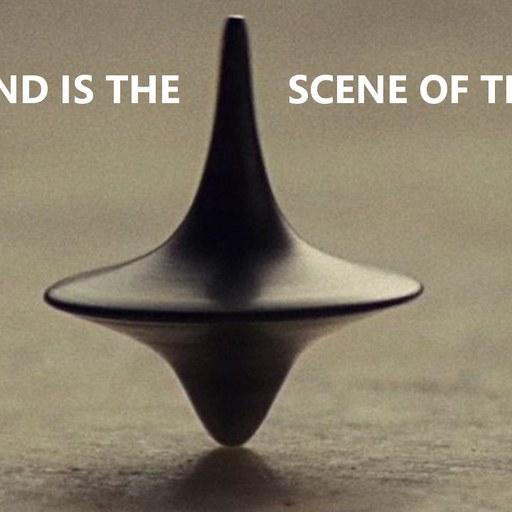

First of all, in mainstream literature, there is debate as to how ordinary spinning tops rise, with almost all of the focus towards sliding and/or rolling friction from the contact on the ground. See my Grok AI discussion with all links to related papers: https://grok.com/share/c2hhcmQtMg_e2aa9cd5-580c-4692-8978-c25c1886e6db
This image illustrates the difference between sliding and rolling friction. https://www.britannica.com/science/rolling-friction

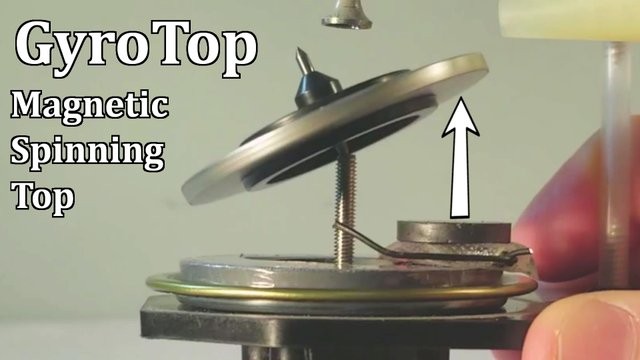
Owen Liang's magnetic spinning top or GyroTop puts the mainstream explanation to serious doubt. See my three videos illustrating his discovery, as well as the associated thumbnails.


In the GyroTop, the tip is very sharp and the top has very little room to move, slide, or roll. Rather, moving the top around causes it to automatically re-align against both gravity and magnetic attraction.
I take this further by showing that a gyroscope placed as a spinning top can rise on its own too, thus completely refuting the rolling vs sliding friction theory. See my following videos:
See full experiments list here: https://mes.fm/experiments-series
The Experiment 1 video above shows that minimizing precessional friction is the key to causing gyroscopes (and hence spinning tops) to rise.
Furthermore, adding tape to increase spin friction can greatly increase the rate of rising.
Thus, in my opinion, the mainstream explanation of how spinning tops rise is almost entirely incorrect.
Furthermore, the very concept of angular momentum is put into question.
The mainstream explanation of angular momentum is that it is the rotational analog of linear momentum. Basically spinning objects have an inertia that hinders any torques trying to change its spin axis. See the image below of a gyroscope balancing vertically: https://en.wikipedia.org/wiki/Angular_momentum

Owen Liang's GyroTop strongly suggests that spinning tops behave as if they don't have this angular momentum, as the top precesses to tilt against its own spin direction, even to oppose magnetic attraction.
The first person that I am aware of that understood that gyroscopes seemingly behave without angular momentum is Professor of Heavy Electrical Engineering Eric Laithwaite, who was also a pioneer in magnetic levitating trains: https://en.wikipedia.org/wiki/Eric_Laithwaite
See this demonstration by Eric Laithwaite showing that a precessing gyroscope behaves inertialess in precession:
I have validated this further by placing the gyroscope on a low friction ice block, to show that horizontal displacement of the ice varies inversely with the spin speed of the gyroscope. See the videos below.
In my opinion, these ice block experiments are irrefutable proof that precession lowers the angular momentum / inertia of spinning objects.
To illustrate what this means, if you had a car-sized gyroscope spinning rapidly, it will precess over a tiny ladder without knocking it over. And if you stood in front of it, you can knock over the car easily (instead of getting run over). https://mes.fm/antigravity-6-rotation-defy-physics

Regarding practical applications, the first thing that comes to mind is torque over-unity, inertial propulsion (useful in space), free energy generator, and much more. See videos below.
The above are examples of the truly limitless applications of a true understanding of the GyroTop, and objects in rotation in general.
I believe the GyroTop should be made available in every physics class around the world!