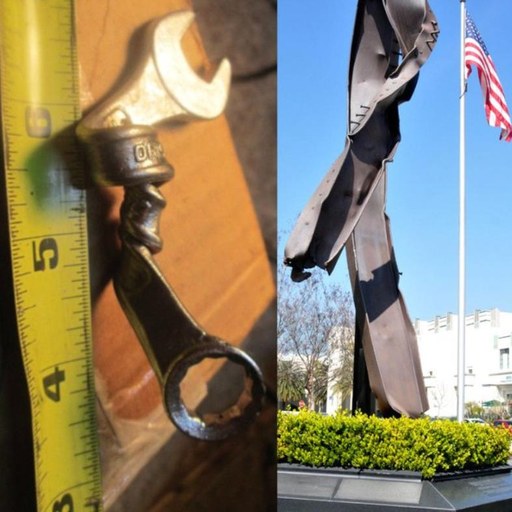

Very interesting Appendix C of the preliminary report on the Hutchison Effect by Los Alamos / US Army Intelligence before filming John’s lab in June 1983. They had 30 hours of filming, yet classified the report, and then destroyed the videos....
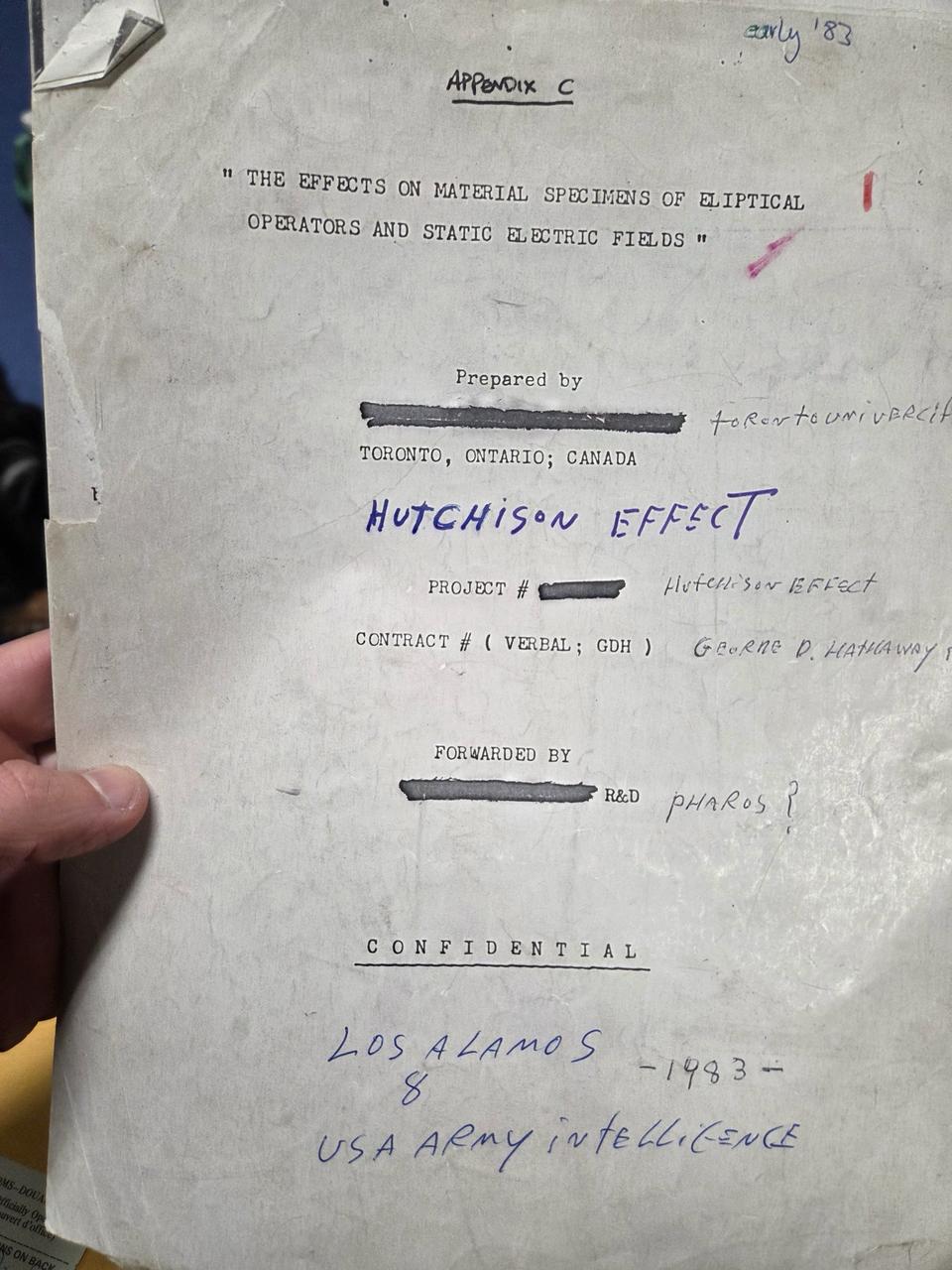
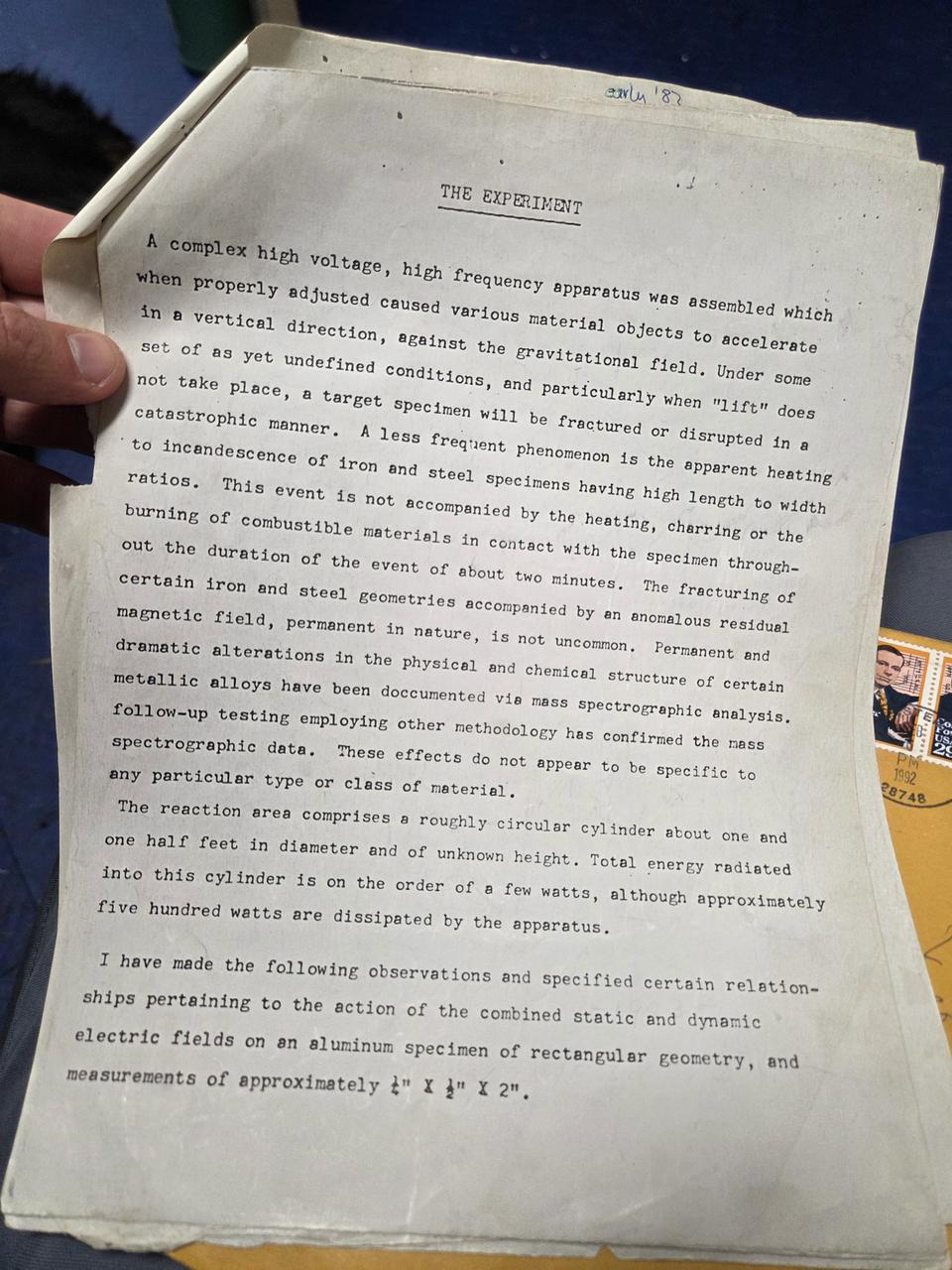
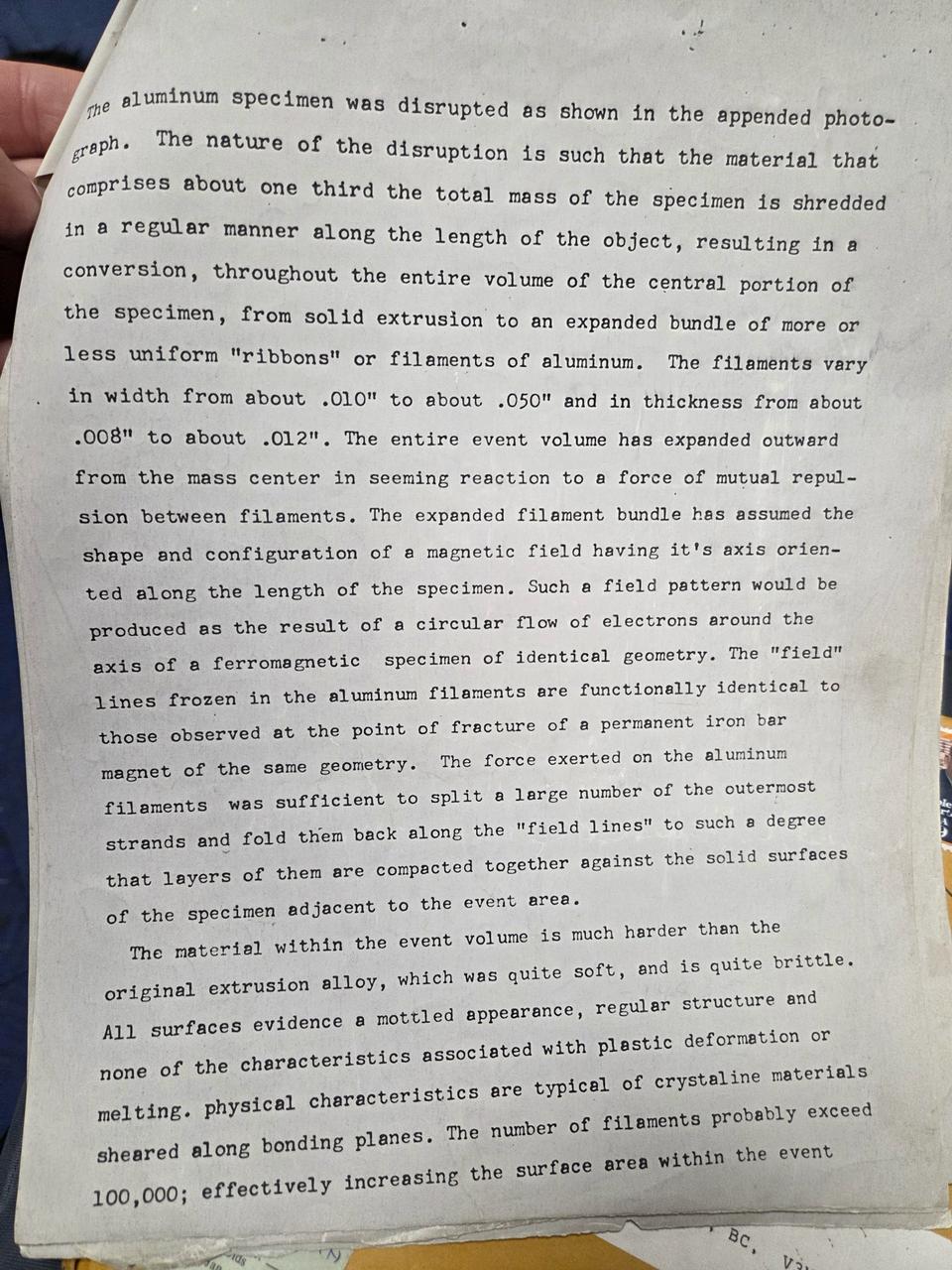

I show this at the 3:00:59 timestamp:
Transcript of Appendix C
Appendix C: transcript
Cover page (handwritten notes shown in italics)
APPENDIX C
"THE EFFECTS ON MATERIAL SPECIMENS OF ELIPTICAL OPERATORS AND STATIC ELECTRIC FIELDS"
Prepared by [REDACTED] (handwritten: Toronto University)
TORONTO, ONTARIO; CANADA
(handwritten, blue ink: HUTCHISON EFFECT)
PROJECT # [REDACTED] (handwritten: Hutchison Effect)
CONTRACT # ( VERBAL; GDH ) (handwritten: George D. Hathaway ?)
FORWARDED BY [REDACTED] R&D (handwritten: Pharos ?)
CONFIDENTIAL
(handwritten, blue ink: Los Alamos 8 -1983- USA Army Intelligence)
(handwritten, top right: early '83)
THE EXPERIMENT
(handwritten, top: early '83)
A complex high voltage, high frequency apparatus was assembled which when properly adjusted caused various material objects to accelerate in a vertical direction, against the gravitational field. Under some set of as yet undefined conditions, and particularly when "lift" does not take place, a target specimen will be fractured or disrupted in a catastrophic manner. A less frequent phenomenon is the apparent heating to incandescence of iron and steel specimens having high length to width ratios. This event is not accompanied by the heating, charring or the burning of combustible materials in contact with the specimen throughout the duration of the event of about two minutes. The fracturing of certain iron and steel geometries accompanied by an anomalous residual magnetic field, permanent in nature, is not uncommon. Permanent and dramatic alterations in the physical and chemical structure of certain metallic alloys have been doccumented [sic] via mass spectrographic analysis. follow-up testing employing other methodology has confirmed the mass spectrographic data. These effects do not appear to be specific to any particular type or class of material.
The reaction area comprises a roughly circular cylinder about one and one half feet in diameter and of unknown height. Total energy radiated into this cylinder is on the order of a few watts, although approximately five hundred watts are dissipated by the apparatus.
I have made the following observations and specified certain relationships pertaining to the action of the combined static and dynamic electric fields on an aluminum specimen of rectangular geometry, and measurements of approximately ¼" x ½" x 2".
The aluminum specimen was disrupted as shown in the appended photograph. The nature of the disruption is such that the material that comprises about one third the total mass of the specimen is shredded in a regular manner along the length of the object, resulting in a conversion, throughout the entire volume of the central portion of the specimen, from solid extrusion to an expanded bundle of more or less uniform "ribbons" or filaments of aluminum. The filaments vary in width from about .010" to about .050" and in thickness from about .008" to about .012". The entire event volume has expanded outward from the mass center in seeming reaction to a force of mutual repulsion between filaments. The expanded filament bundle has assumed the shape and configuration of a magnetic field having it's [sic] axis oriented along the length of the specimen. Such a field pattern would be produced as the result of a circular flow of electrons around the axis of a ferromagnetic specimen of identical geometry. The "field" lines frozen in the aluminum filaments are functionally identical to those observed at the point of fracture of a permanent iron bar magnet of the same geometry. The force exerted on the aluminum filaments was sufficient to split a large number of the outermost strands and fold them back along the "field lines" to such a degree that layers of them are compacted together against the solid surfaces of the specimen adjacent to the event area.
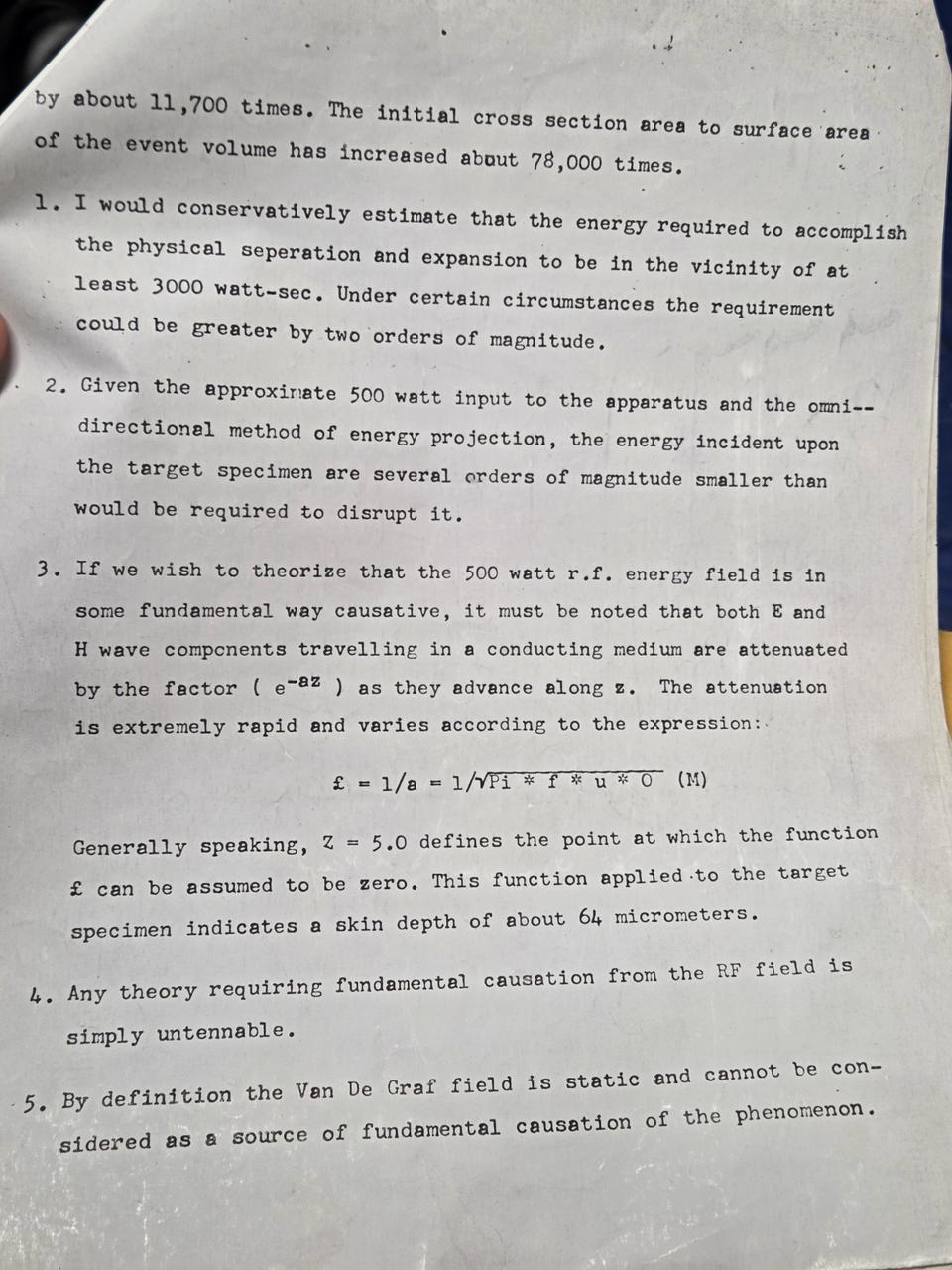
The material within the event volume is much harder than the original extrusion alloy, which was quite soft, and is quite brittle. All surfaces evidence a mottled appearance, regular structure and none of the characteristics associated with plastic deformation or melting. physical characteristics are typical of crystaline [sic] materials sheared along bonding planes. The number of filaments probably exceed 100,000; effectively increasing the surface area within the event volume by about 11,700 times. The initial cross section area to surface area of the event volume has increased about 78,000 times.
I would conservatively estimate that the energy required to accomplish the physical seperation [sic] and expansion to be in the vicinity of at least 3000 watt-sec. Under certain circumstances the requirement could be greater by two orders of magnitude.
Given the approximate 500 watt input to the apparatus and the omni-directional method of energy projection, the energy incident upon the target specimen are several orders of magnitude smaller than would be required to disrupt it.
If we wish to theorize that the 500 watt r.f. energy field is in some fundamental way causative, it must be noted that both E and H wave components travelling in a conducting medium are attenuated by the factor ( e^(-az) ) as they advance along z. The attenuation is extremely rapid and varies according to the expression:
£ = 1/a = 1/√Pi * f * u * 0 (M)Generally speaking, Z = 5.0 defines the point at which the function £ can be assumed to be zero. This function applied to the target specimen indicates a skin depth of about 64 micrometers.
Any theory requiring fundamental causation from the RF field is simply untennable [sic].
By definition the Van De Graf field is static and cannot be considered as a source of fundamental causation of the phenomenon.
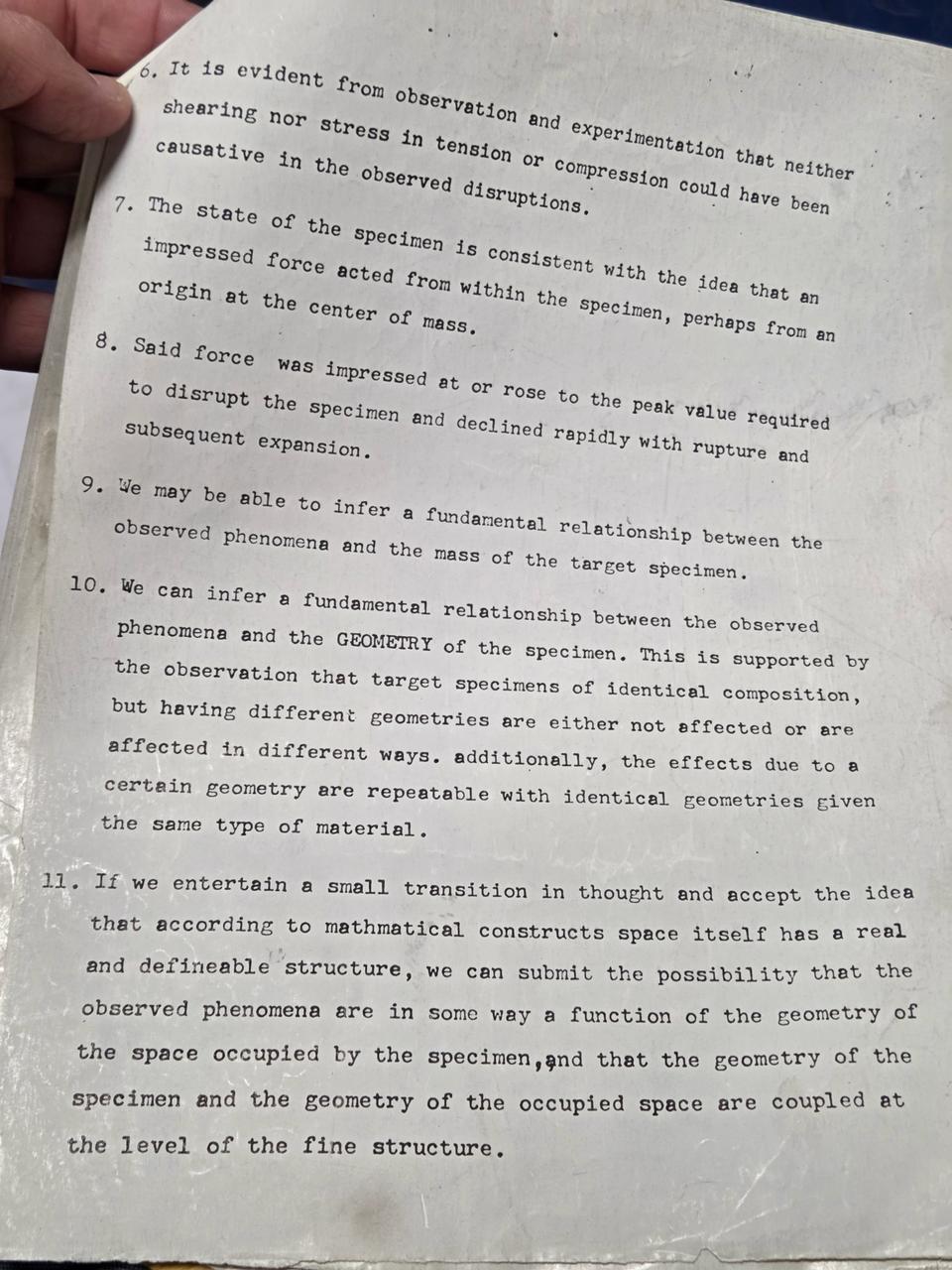
It is evident from observation and experimentation that neither shearing nor stress in tension or compression could have been causative in the observed disruptions.
The state of the specimen is consistent with the idea that an impressed force acted from within the specimen, perhaps from an origin at the center of mass.
Said force was impressed at or rose to the peak value required to disrupt the specimen and declined rapidly with rupture and subsequent expansion.
We may be able to infer a fundamental relationship between the observed phenomena and the mass of the target specimen.
We can infer a fundamental relationship between the observed phenomena and the GEOMETRY of the specimen. This is supported by the observation that target specimens of identical composition, but having different geometries are either not affected or are affected in different ways. additionally, the effects due to a certain geometry are repeatable with identical geometries given the same type of material.
If we entertain a small transition in thought and accept the idea that according to mathmatical [sic] constructs space itself has a real and defineable [sic] structure, we can submit the possibility that the observed phenomena are in some way a function of the geometry of the space occupied by the specimen, and that the geometry of the specimen and the geometry of the occupied space are coupled at the level of the fine structure.
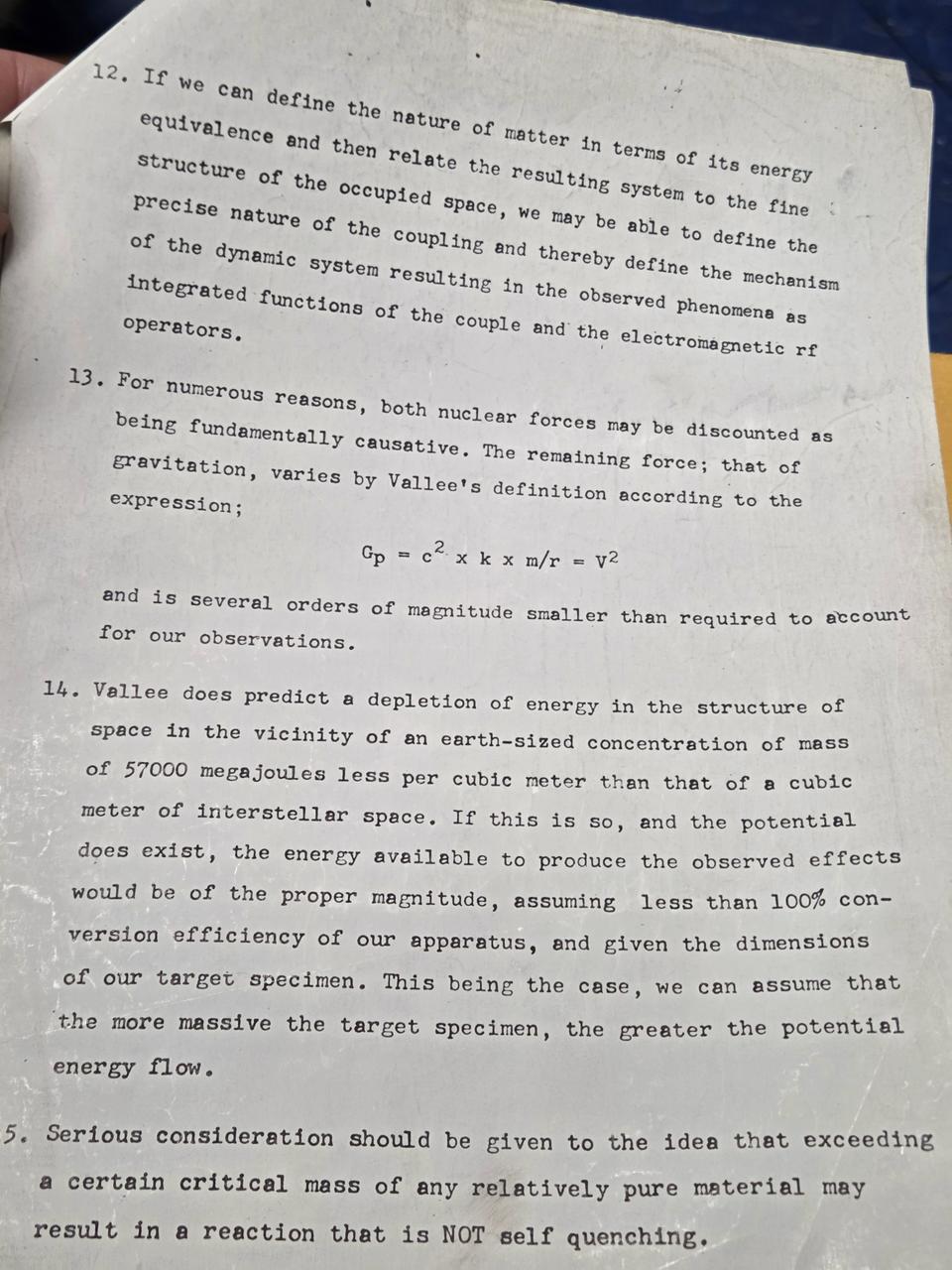
If we can define the nature of matter in terms of its energy equivalence and then relate the resulting system to the fine structure of the occupied space, we may be able to define the precise nature of the coupling and thereby define the mechanism of the dynamic system resulting in the observed phenomena as integrated functions of the couple and the electromagnetic rf operators.
For numerous reasons, both nuclear forces may be discounted as being fundamentally causative. The remaining force; that of gravitation, varies by Vallee's definition according to the expression;
Gp = c² x k x m/r = V²and is several orders of magnitude smaller than required to account for our observations.
Vallee does predict a depletion of energy in the structure of space in the vicinity of an earth-sized concentration of mass of 57000 megajoules less per cubic meter than that of a cubic meter of interstellar space. If this is so, and the potential does exist, the energy available to produce the observed effects would be of the proper magnitude, assuming less than 100% conversion efficiency of our apparatus, and given the dimensions of our target specimen. This being the case, we can assume that the more massive the target specimen, the greater the potential energy flow.
(number cut off at the page edge; it reads "5." in the photo) Serious consideration should be given to the idea that exceeding a certain critical mass of any relatively pure material may result in a reaction that is NOT self quenching.
The envelope
Mailing envelope the report was sent in:
- Return address: ELECTRIC SPACECRAFT JOURNAL, P.O. Box 18387, Asheville, North Carolina 28814, USA
- Addressed to: John Hutchison, 911 Dublin Street, New Westminster, BC, V3M 2Y5, CANADA
- Markings: red stamp "AIR MAIL"; postmarked 1992, 28748 (Cole Porter 29¢ stamps x5, Margaret Mitchell 1¢ stamps x3)
- Handwritten: "ORIGINAL PHAROS" and, circled, "SPACE time"
- Customs label (PS Form 2976, Jan. 1986): "Contents in detail: Printed Matt[er]", value 0
- Hive: inleo.io/@mes/los-alamos-report-appendix-c-of-the-hutchison-effect-b24
- Telegram: t.me/meslinks/32670
- Hutchison Effect: mes.fm/hutchison
Originally posted on the Hive blockchain →