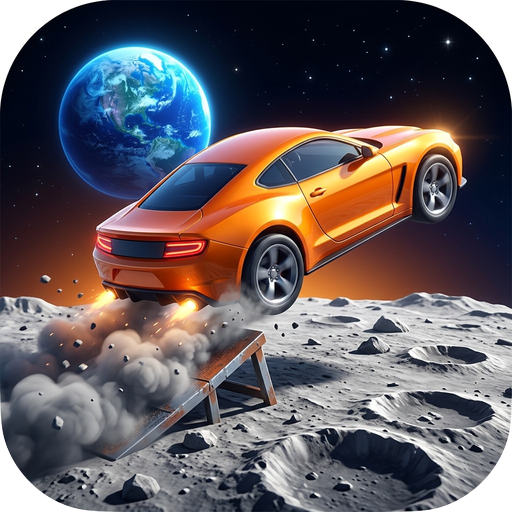

3D Car Sandbox: Drive on the Moon, Mars and a Test Track with Real Physics
A free 3D driving sandbox with real physics: drive sports cars, trucks, a bus, a monster truck, a buggy or a lunar rover on an Earth test track, the Moon, Mars or Ceres, jump ramps, loop the loop, crash into computer cars and knock over crates, walls, dominoes and watermelons, and change gravity from zero to the Sun's.
- W A S D or the arrow keys · S at a stop = reverse
- Space handbrake (drift) · Shift boost
- R back on your wheels · C camera · Tab drive another car
- Laps are timed on the track: cross the chequered line, keep to the track, sector times show how you compare with your best, and a see-through ghost car drives your best lap
- Flip or roll in the air and land on your wheels for a stunt
- Y instant replay of the last 12 s · N night / day · K weather
- G flip gravity · O drop a random object · H horn · M sound · P pause
- In the air, the pedals tip the nose and steering rolls the car
- Drag the picture to look around · a game controller works too
Drag through sunrise and sunset to see the sun move, the sky change colour and the shadows grow. At dusk the lamp posts and headlights switch on.
A free 3D car sandbox with real physics
Drive a sports car, SUV, pickup, bus, monster truck, dune buggy, go-kart or lunar rover around an Earth test track, across the craters of the Moon, over the dunes of Mars or on the dwarf planet Ceres. Fly off ramps, loop the loop, ride the half pipe, crash into the computer cars and knock over crate pyramids, brick walls, dominoes, bowling pins and watermelons. Change gravity at any time, from zero to the Sun's, or flip it upside down for a few seconds.
What is really simulated
Every car is a rigid body with four suspension springs, and every loose object has its own mass, friction and bounce (the physics engine is Rapier, running in your browser). Two things make the worlds feel different, and both are real physics:
- Grip comes from weight. A tyre can only push sideways or brake with a force of about its friction coefficient times the load on it. On the Moon a car weighs one sixth of what it does on Earth, so it brakes and corners six times more weakly: stopping from 100 km/h takes about 39 m on Earth and about 240 m on the Moon. Astronauts drove the Apollo rovers at about 10 to 15 km/h for exactly this reason.
- Jumps scale with 1 / g. Leave a ramp at the same speed and angle and you fly six times as far and six times as long on the Moon, and 35 times as far on Ceres. The dust thrown up by the wheels follows the same arcs, and on airless worlds it falls straight back without drifting.
There is also air drag (none on the Moon and Ceres, very little on Mars), rolling resistance, a tapering engine force, and crashes: when a car's velocity changes much faster than gravity and its springs could do it, that is an impact. The felt g-force is shown, the body dents where it was hit, and the engine gets weaker as the damage goes up.
Questions
- Why does the car slide so much on the Moon?
- Because friction is proportional to the force pressing the tyres down, and that force is the car's weight. Less gravity means less weight, so less grip, while the car's mass (its resistance to changing direction) is the same.
- What happens at zero gravity?
- Nothing holds the tyres on the ground, so there is no grip at all: the engine can't push and the car just keeps drifting. Bump an object and it floats away in a straight line forever.
- Is the Jupiter world real?
- No: Jupiter has no solid surface. That world is an imaginary flat surface with Jupiter's gravity (24.8 m/s²), so you can feel how heavy everything gets. The suspension squashes, jumps are short and crashes hurt.
- Does it work on a phone?
- Yes. Touch buttons appear on touch screens (steer on the left, pedals on the right), and "Fill window" makes the picture fill the screen. A game controller (gamepad) works on computers.
- How do the lap timer and the ghost work?
- On the test track, crossing the chequered line starts the timer. A lap only counts if you go round all four quarters in order. Your best lap is kept for each car and gravity, and a see-through ghost car replays it while you drive, so you can see exactly where you gain or lose time.
- Does the weather change how the car drives?
- Yes. A wet road gives the tyres about 70% of their dry grip, a thunderstorm about 60% and packed snow only about a third, so you need much more room to stop and must take bends slower. The stopping distance shown under the gravity controls includes it. The Moon and Ceres have no air, so they have no weather at all.
- Can I watch a crash again?
- Yes: the last 12 seconds of every car and object are always kept. Press Y (or the 🎬 button) for an instant replay with TV cameras, a chase camera or an orbit you can drag, in slow motion if you like, and drag the bar to any moment.
- How does the time of day work?
- Pick any hour with the slider, or press "Run the day" and choose how long a whole day takes (from 2 minutes to real time). The sun rises at 6:00, is highest at noon and sets at 18:00; low sun gives long shadows and an orange sky, and on Mars the sunset glows blue, as photographed by NASA’s rovers. On the real Moon a day lasts about 29.5 Earth days.
- What does night driving change?
- The sun goes down, stars come out, the lamp posts along the track glow and your car’s headlights light the road. On the Moon the only light left is earthshine (sunlight reflected off the Earth), so the headlights matter a lot.
- Is anything saved or uploaded?
- Only your settings, records and best-lap ghosts, in your own browser. Nothing is uploaded.