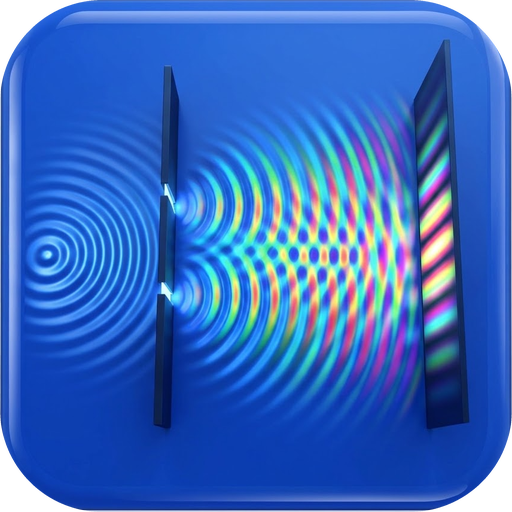

Spin Wave Field: Double Slit with a Wave of People and Spin-½ Phase
A free double-slit simulator where a crowd of people turns with the phase of the wave, so you can watch interference fringes form (d sin θ = mλ); a spin-½ phase field where a 360° turn in one slit flips the sign and shifts the fringes by half, and 720° brings them back; and a 3D wave field with tracer particles.
Think of a stadium wave. Every person in the crowd is a tiny piece of a medium: they raise and lower their arms in step with the wave that reaches them. A wave comes in from the left, hits a wall with two slits, and each slit becomes a new source (Huygens' principle). Behind the wall the two waves add up: where they arrive in step people wave wildly, where they arrive out of step people stand still. The board at the back counts where "hits" land, and it builds up the famous stripes. Drag the picture to look around.
The same crowd, but slit 1 now has a spin flipper: a coil that turns whatever goes through by an angle α. The people standing inside it hold an arrow that turns by the full angle α, and wear a colour for the sign of the medium, which goes as cos(α/2). At 360° the arrow is back where it started, yet the colour is red (minus): the wave through slit 1 is now upside down, so the stripes on the board move by half a stripe. Only at 720° is everything back to normal. Neutrons really do this (see the Spin Simulator).
Now forget the people: the medium is a continuous sheet, solved live with the wave equation. The height is how far the sheet is pushed up, and the colour is the phase (where each point is in its cycle, round the colour wheel). Drive it from a point, two points, or a plane wave hitting a wall with slits, and watch plane waves, circular waves and interference stripes emerge on their own. Click the sheet to drop a tracer particle: it rides the waves and drifts with the flow of energy, so tracers collect in the bright stripes. Drag to turn, Ctrl + wheel or pinch to zoom.
How the spin wave field works
Everything is computed in your browser; nothing is uploaded. The first two pictures use Huygens' principle: every point of each slit sends out a new circular wave, and the wave at any person is the sum of all of them. The third solves the wave equation on a grid of cells, step by step. The fringe positions are standard wave optics and are checked against the textbook formulas in the page's tests.
A wave of people
Each person's arms follow u(t) = |ψ| cos(φ − ωt): the size of the wave decides how far they move, the phase φ decides when. In Phase colouring the shirt goes round the colour wheel with φ − ωt, so a line of one colour is a wave crest, and you can see the crests coming out of the two slits as half-circles. Along the dark stripes the two waves arrive half a cycle apart and cancel, so those people stand still. The board counts "hits" at random, with the chance at each place proportional to |ψ|²: one hit at a time the stripes appear, the way single photons or electrons build up the pattern in a real double-slit experiment.
Spin-½: the arrow and the sign
A spin-½ particle turned by an angle α picks up the factor e−iασ/2, which is −1 for a full turn. The arrow you could draw for its spin is back after 360°, but the wave itself has changed sign; you only notice when it meets a second wave that did not turn. That is why the flipper in one slit swaps the bright and dark stripes at 360° and needs 720° to undo it (Rauch et al. and Werner et al. saw this with neutrons in 1975). An ordinary vector (the "Ordinary vector" button) has no hidden sign: its stripes are back at 360°. Chantal Roth's model pictures the wave as a twist in an elastic medium, where the arrow is the visible orientation and the sign is the medium's hidden state; that is a hypothesis, and the page uses it only as a picture.
The spin field
The sheet is a grid of cells obeying utt = c² ∇²u (leapfrog steps, Courant number 0.5), with a soft absorbing border so waves leave instead of bouncing back. Walls are cells held at zero. The phase colour comes from the displacement u and its rate of change: u = A cos φ and ut = −ωA sin φ. Tracers move along the energy flow S/E, smoothed in time; this is an illustration of how something carried by a wave ends up where the wave is strongest, not a claim about how real particles move.
Questions
- Why are the stripes evenly spaced?
- For small angles sin θ ≈ θ ≈ y / L, so d y / L = mλ gives y = mλL/d: the same step every time. At bigger angles the exact formula (shown by the dashed lines) spreads them out.
- Why does a wider slit make the stripes fade at the sides?
- Each slit on its own gives a broad central bump with dark points at a sin θ = mλ. The two-slit stripes sit inside that bump (the "envelope").
- Do real people (or a real medium) carry light like this?
- The crowd is an analogy, like a stadium wave. Whether light and matter are waves in a physical medium is an open idea (Chantal Roth's elastic-medium model is one version); the maths of the stripes is the same either way.
- What does 360° vs 720° have to do with the double slit?
- Interference compares two paths. If one path's wave picks up −1, bright and dark swap. A spin-½ wave picks up −1 after one turn, so a 360° turn in one slit shifts the stripes by half a stripe; two turns put them back.
- Is the field tab exact?
- It is a numerical solution on a grid: waves shorter than about 8 cells travel a little slow, and the absorbing edges reflect about a percent. The stripe spacing still follows d sin θ = mλ.
Related: Spin & Angular Momentum Simulator · Diffraction in the Light & Metamaterials Lab · Light in a Medium · Hologram Simulator · MES Physics · More MES tools