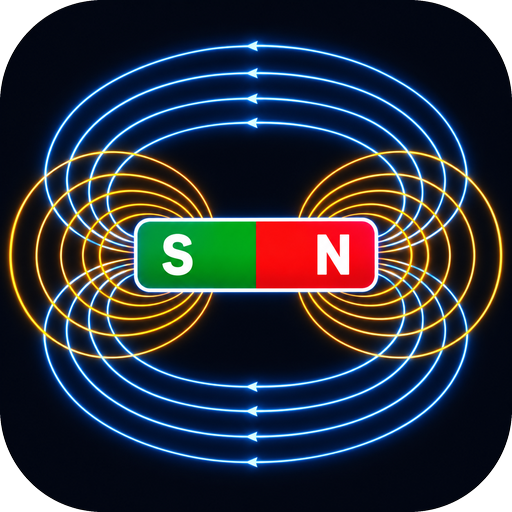

Magnetic Isopotentials and Flux Lines of Bar Magnets
Free magnet simulator: drag and turn bar magnets and see their magnetic flux lines and isopotential lines (equal magnetic scalar potential) at once, with compasses, field strength colours, horseshoe and Halbach examples.
⚡ Part of the Electromagnetic Fields Simulator · electric charges, currents, charged particles and light waves are in the other tabs there.
Bar magnets and the two families of lines around them. Flux lines (the usual “magnetic field lines”) show which way B points; they leave the N end, curve round and go back in at the S end, and carry on inside the magnet from S to N, so every line is a closed loop. Isopotentials are lines of equal magnetic scalar potential ψ, like the contour lines on a map; outside the magnet they cross the flux lines at right angles. Drag a magnet to move it, grab its round handle (or use the mouse wheel over it) to turn it.
All magnets
Tip: click a magnet to select it (the sliders then change only that one; click empty space to change all of them). R / Shift+R turns the selected magnet, Backspace or Delete removes it. The handle snaps to 5°; hold Shift while turning for any angle. Compasses: drag them around, their red end points the way B does.
 Video · MES PhysicsMagnetic Isopotentials Explain the Faraday Paradox, Stern-Gerlach Experiment, and Atomic Orbitals
Further exploration
Watch the video above, and see all of the MES Physics videos.
Lori Gardi (FractalWoman) and Michael Snyder discuss magnetic isopotentials: why the lines of equal potential, not only the flux lines, are worth drawing and measuring. Lori's channel: FractalWoman on YouTube, including her playlist On Magnetic Isopotentials.
PlayMagnet, free apps by Michael Snyder for placing magnets and seeing their isopotentials and field lines:
Magnetic isopotentials and flux lines
Short link: mes.fm/magnetic-isopotentials
The usual picture of a magnet shows only its flux lines (field lines): curves that follow the direction of the magnetic field B. There is a second set of lines that is drawn far less often: the isopotentials, lines along which the magnetic scalar potential ψ has the same value. They are the magnetic version of the equipotentials around electric charges, or the height contours on a map. Where no electric current flows, the field can be written as the slope of ψ, H = −∇ψ, so the isopotentials cross the flux lines at right angles and the field is strongest where they crowd together.
How the picture is computed
Each magnet is a long, uniformly magnetised block seen end-on (a two-dimensional model). In the magnetic charge (Gilbert) picture its N face carries a sheet of “north pole” of strength +M per metre and its S face an equal sheet of −M. Each sheet adds −σ ln r / 2π to ψ, integrated exactly over the face, so the field stays smooth right up to the ends instead of blowing up at two point poles. In the current (Ampère) picture the same magnet is two thin current sheets on its long sides; their vector potential Az is constant along each flux line, so the flux lines are drawn as its contours, with the same magnetic flux between neighbouring lines. The two pictures give the same B everywhere (checked in the tests to 1 part in 100,000).
Why the flux lines go through the magnet
Inside the magnet H points from N back to S (it is the “demagnetising” field of the pole sheets), but B = μ₀(H + M) points from S to N. That is why every flux line is a closed loop: out of the N end, round through the air, in at the S end and on through the magnet. The isopotentials are drawn inside too, but there they are no longer perpendicular to the flux lines, because B and H point different ways inside.
Questions
- What is a magnetic isopotential?
- A line (or, in 3D, a surface) on which the magnetic scalar potential ψ is constant. Moving along it, a test north pole would feel no push along the line. Outside a magnet the isopotentials cross the flux lines at right angles.
- Is the magnetic scalar potential always defined?
- Only where no current flows. Around a current-carrying wire the field circles round, so going once round the wire changes ψ by the current: it cannot be a single-valued potential there. For permanent magnets in air it works everywhere.
- Why are the poles coloured red and green?
- N is red and S is green, a common colour scheme for magnet diagrams. Compass needles point their red end the way B points.
- How strong are real magnets?
- The strength slider is the remanence Br: about 0.2 T for a flexible fridge magnet, 0.4 T for ferrite and 1.2 to 1.45 T for neodymium. A long thin magnet keeps nearly Br inside; a short, wide one is demagnetised by its own poles and has less (both checked in the tests).
- Is this exact?
- The formulas are exact for the 2D model: magnets that are long out of the screen, perfectly uniformly magnetised and not affected by each other's fields (a good approximation for neodymium and ferrite, not for soft iron). Real short magnets in 3D have fields that fall off faster far away (1/r³ instead of 1/r²) but look much the same near the magnet.
Open it in the full Electromagnetic Fields Simulator · MES Physics videos · MES Science · More MES tools