
In this video, I review the Mechanics of Materials needed to solve Problem 1 of the EM 304 test that Dr. Judy Wood gave her students on February 6, 2003, five days after the Space Shuttle Columbia disaster. I cover strain and thermal expansion, the 2014-T6 aluminum alloy used in the aerospace industry, and the elastic constants: Young's modulus (stress and the stress-strain curve), the shear modulus (shear stress and shear strain), and Poisson's ratio. At the end, I show the free MES Mechanics of Materials calculator at mes.fm/materials, try it out yourself!
Watch on: Notes · YouTube · Rumble · Odysee · BitChute · Telegram
Timestamps:
- 0:00 Review of Mechanics of Materials
- 0:19 Strain and thermal expansion
- 0:52 Strain is relative deformation compared to a referenced position
- 1:58 Thermal expansion is the tendency of matter to increase in size with increasing temperature
- 4:15 2014-T6 aluminum alloy is often used in the aerospace industry
- 5:28 T6 temper involves solution heat-treating and artificially aging until the metal meets standard mech
- 7:44 Elastic constants
- 8:57 Young's modulus is the axial stress divided by the axial strain
- 9:23 Stress describes the forces present during deformation of materials
- 10:44 Typical stress-strain curve for a material under axial stress
- 12:31 Shear modulus is the shear stress divided by the shear strain
- 13:59 Shear stress is the shear force coplanar with a material cross section divided by that cross section area
- 15:55 Poisson's ratio is the lateral or transverse strain divided by the axial strain (a negative sign is included so the ratio is positive)
- 20:11 MES Mechanics of Materials calculator – https://mes.fm/materials
Notes and playlists:
- Full video: https://mes.fm/space-shuttle-columbia
- Playlist: https://www.youtube.com/playlist?list=PLEJOImrX4SIc
- https://mes.fm/math
Notes: Solution: Review of Mechanics of Materials
Written notes — mirrored from Exam Problem by Dr. Judy Wood: Space Shuttle Columbia Disaster, which has the full video and the complete solution.
Solution: Review of Mechanics of Materials
Note that I will be using Grok AI's assistance in the solution, as well as Dr. Judy Wood's solution key: https://grok.com/share/c2hhcmQtMg_4766b37c-cfd8-4dea-897f-42a2e51d1568
Let's first cover some of the mechanics of materials terms first.
Strain and Thermal Expansion
We are given the thermal strain for the support plates and aluminum tube, via their coefficients of thermal expansion:
- αplate = 0.00 με/°F
- αal = 12.8 με/°F
Strain is the relative deformation compared to a reference position, and has SI base units of meter per meter (m/m).
α is the coefficient of linear thermal expansion (tendency of matter to increase in size with increasing temperature).

Figure: Expansion joint in a road bridge used to avoid damage from thermal expansion.
The units με/°F = microstrain per degree Fahrenheit = 10-6 strain per °F.
10-6 strain corresponds to 1 unit of length changed per 1,000,000 unit of length, aka 1 part per million.
For example, aluminum expands by 12.8 millionths of an inch per inch of length for every 1 °F temperature increase.
The plates are assumed to not expand at all with temperature, hence αplate = 0.
2014-T6 Aluminum Alloy
2014 aluminium alloy (or aluminum in USA / Canada) is an aluminum-based alloy often used in the aerospace industry.
The T6 refers to the tempering process used, which is a process of heat treating used to increase the toughness of (typically) iron-based alloys.

Figure: Differentially tempered steel. The various colors produced indicate the temperature the steel was heated to. Light straw indicates 204 °C (399 °F) and light blue indicates 337 °C (639 °F).[1][2]
The T6 temper involves solution heat-treating and artificially aging until the metal meets standard mechanical property requirements.

The graph bars on the material properties cards above compare 2014-T6 aluminum to: 2000-series alloys (top), all aluminum alloys (middle), and the entire database (bottom). A full bar means this is the highest value in the relevant set. A half-full bar means it's 50% of the highest, and so on. For example, the Brinell Hardness and Elastic Modulus of 2014-T6 aluminum is very high compared with other aluminum alloys.
Elastic Constants
We are given the elastic constants for the support plates and aluminum tube:
- Eplate = ∞, G = ∞, v = 0 (rigid)
- Eal = 10.6 Msi, G = 3.9 Msi, v = 0.34
Young's modulus (or the Young modulus), E, is a measure of the tensile or compressive stiffness when a force is applied lengthwise.
Young's modulus is given by the equation of stress (force per unit area) divided by the strain.

Stress (σ for axial stress) describes the forces present during deformation.

Figure: Mechanical stress
 Figure: Idealized stress in a straight bar with uniform cross-section.

Figure: The slope of the linear part of the stress–strain curve for a material under tension or compression
Figure: Relationship between Young's modulus and deformation under stretching aluminum
The Shear Modulus or modulus of rigidity, G or sometimes S or μ, is a measure of the elastic shear stiffness of a material and is defined (hence the := sign) as the ratio of shear stress to shear strain.


Figure: Shear strain
Shear stress, τ, is the component of stress coplanar (on the same plane) with a material cross section. It arises from the shear force, the component of the force vector parallel to the material cross section. Normal stress, on the other hand, arises from the force vector component perpendicular to the material cross section on which it acts.


Figure: Side view of a parallelepiped where a shearing force is applied to the top of a rectangular cuboid while the bottom is held in place. The resulting shear stress, τ, deforms the cuboid's rectangular side into a parallelogram. The area involved would be the top of the parallelopiped.
Poisson's ratio, ν, is a measure of the Poisson effect, the deformation (expansion or contraction) of a material in directions perpendicular to the specific direction of loading.

Figure: Poisson's ratio of a material defines the ratio of transverse strain (or lateral strain) (x direction) to the axial strain (y direction).

Figure: A cube with sides of length L of an isotropic linearly elastic material subject to tension along the x axis, with a Poisson's ratio of 0.5. The green cube is unstrained, the red is expanded in the x-direction by ΔL due to tension, and contracted in the y- and z-directions by ΔL′.

Thermal Expansion Properties of the Support Plates and Aluminum Tube
In summary, the support plates are considered idealized as perfectly rigid and non-expanding, hence having a coefficient of thermal expansion of zero, an infinite Young's modulus, infinite shear modulus, and a Poisson's ratio of zero.
While the aluminum tube has a coefficient of thermal expansion of 12.8 με/°F, a Young's modulus of 10.6 Msi (million psi aka million pounds per square inch), shear modulus of 3.9 Msi, and Poisson's ratio of 0.34 (the transverse strain is 34% of axial strain).
Strength Limits (Allowable Stresses)
We are also given the following strength limits for the support plates and the aluminum tube, at which the material is considered to fail (either yield or ultimate strength, depending on the design criteria):
Plates:
- τmax = 10.2 ksi = maximum allowable shear stress
- σmax = 104 ksi (tension) = maximum allowable normal stress in tension
- σmmax = 70 ksi (compression) = maximum allowable normal stress in compression
Aluminum:
- τmax = 19 ksi
- σmax = 60 ksi (tension)
- σmax = 60 ksi (compression)
Note that ksi = kips per square inch = 1000 pounds per square inch = 1000 psi
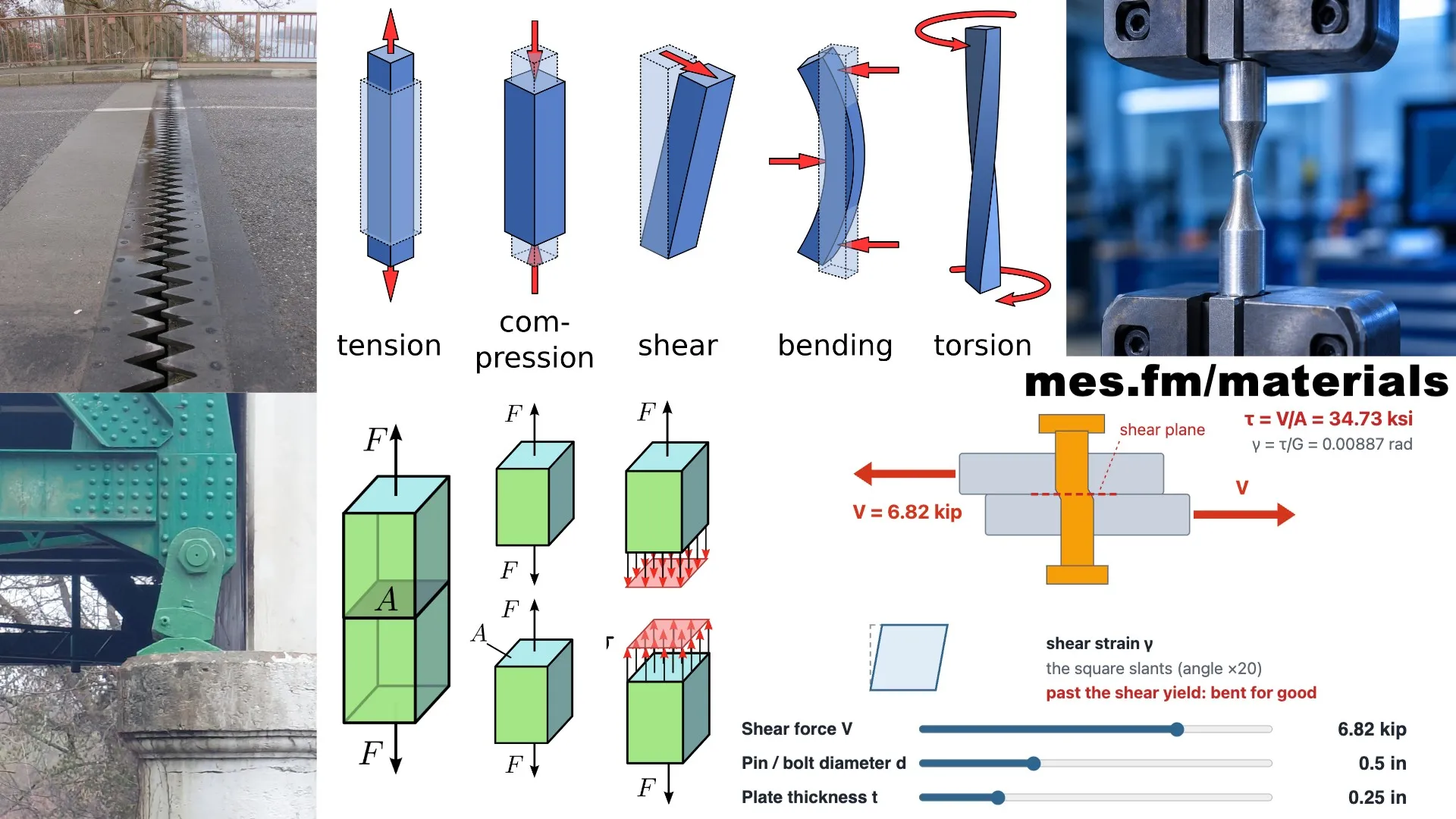
MES Mechanics of Materials Calculator: https://mes.fm/materials
Play around with it and let me know what you think!
I made it with Claude Code AI.
- Watch on: 3Speak · YouTube · Rumble · Odysee · BitChute · Telegram
- Full video and written notes: Exam Problem by Dr. Judy Wood: Space Shuttle Columbia Disaster
- Playlist: Space Shuttle Columbia Disaster YouTube playlist
- More math: mes.fm/math
Originally posted on the Hive blockchain →