
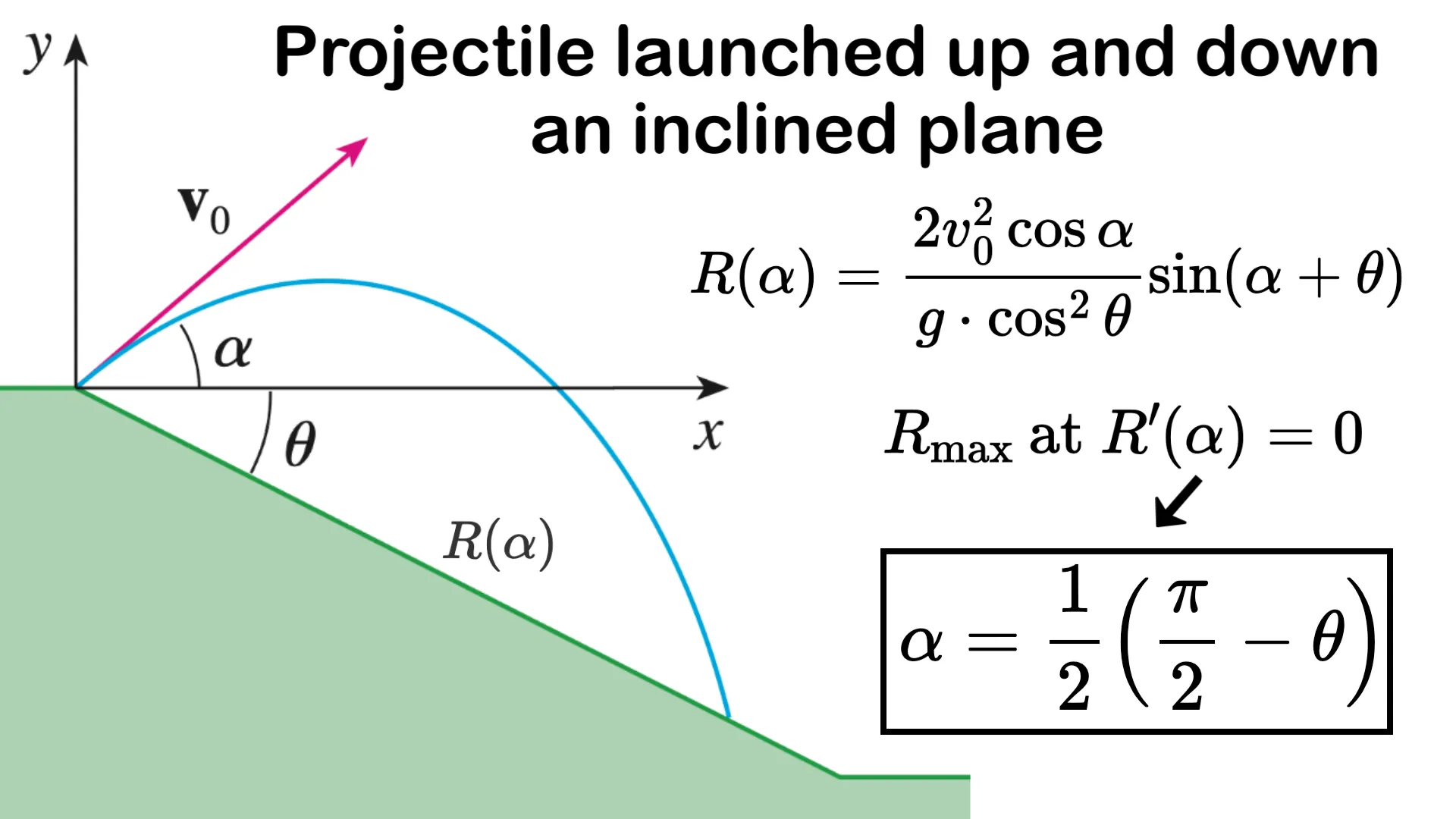
In this video, I go over projectile motion along an inclined plane and show that the launch angle that gives the maximum range upwards or downwards is half the angle between the plane and the vertical. Even when firing at a target up an inclined plane, the angle that minimizes the energy used is also half the angle between the plane and the vertical. This result also matches for a flat plane, since the maximum distance is achieved for a launch angle of 45°, i.e. half the angle between the plane (0°) and the vertical (90°).
- Watch on: 3Speak · YouTube · Telegram
- Full written solution: Vector Functions: Problems Plus
- More math: mes.fm/math
Solution to Problem 2
Full written solution to parts (a), (b), (c) and (d) — mirrored from Vector Functions: Problems Plus, which also covers Problem 1 and Problems 3–7.
(a) A projectile is fired from the origin down an inclined plane that makes an angle θ with the horizontal.
The angle of elevation of the gun and initial speed of the projectile are α and v0, respectively.
Find the position vector of the projectile and the parametric equations of the path of the projectile as functions of time t.
Ignore air resistance.
(b) Show that the angle of elevation α that will maximize the downhill range is the angle halfway between the plane and the vertical.
(c) Suppose the projectile is fired up an inclined plane whose angle of inclination is θ.
Show that, in order to maximize the (uphill) range, the projectile should be fired in the direction halfway between the plane and the vertical.
(d) In a paper presented in 1686, Edmond Halley summarized the laws of gravity and projectile motion and applied them to gunnery.
One problem he posed involved firing a projectile to hit a target a distance R up an inclined plane.
Show that the angle at which the projectile should be fired to hit the target but use the least amount of energy is the same as the angel in part (c).
Use the fact that the energy needed to fire the projectile is proportional to the square of the initial speed, so minimizing the energy is equivalent to minimizing the initial speed.

Solution to (a)
As in Problem 1:

The difference here is that the projectile travels until it reaches a point where:

From the parametric equations, we obtain:

Thus the projectile hits the inclined plane at the point where:

This means that the parametric equations are defined for t in the interval:

Solution to (b)
The downhill range (that is, the distance to the projectile's landing point as measured along the inclined plane) is:

Where x is the coordinate of the landing point calculated in part (a).

Recall the sine and cosine adding angles trigonometric identities from my earlier video.

R(α) is maximized when:


Solution to (c)
The solution is similar to the solutions to parts (a) and (b).
This time the projectile travels until it reaches a point where:

Thus we can just replace θ with -θ in Parts (a) and (b) to obtain the angle:

Solution to (d)
As observed in part (c), firing the projectile up an inclined plane with angle of inclination θ involves the same equations in part (a) and (b) but with θ replaced with -θ.
So if R is the distance up an inclined plane, we know from part (b) that:

(v0)2 is minimized (and hence v0 is minimized) with respect to α when:


Thus the initial speed, and hence the energy required, is the same angle as in part (c), and which is half the angle between the vertical and the plane.
Recall the quotient rule for derivatives from my earlier video.

Originally posted on the Hive blockchain →