
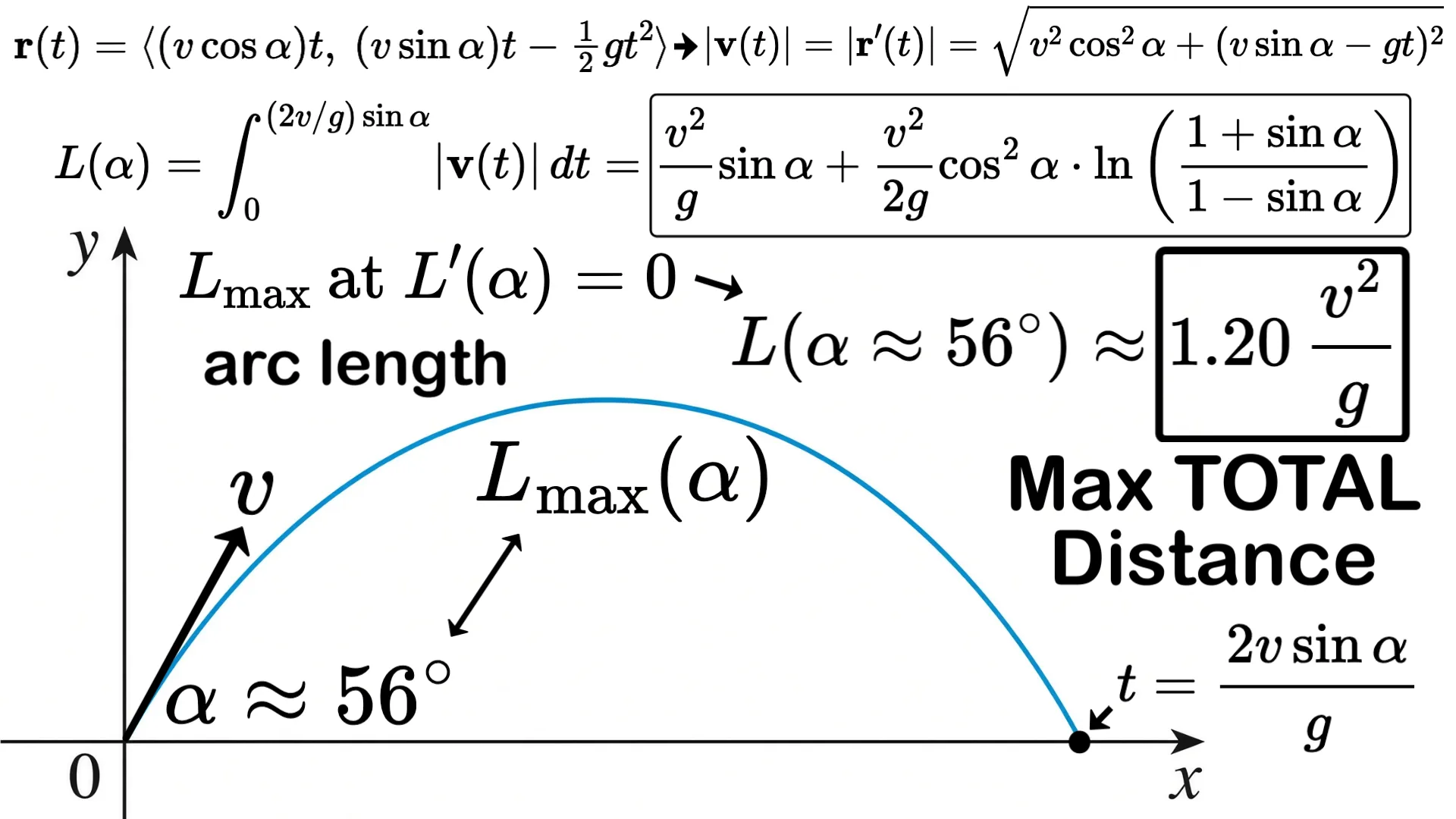
In this video, I show that firing a projectile has a maximum total distance traveled in the air when the launch angle is approximately 56°. This is 11° higher than the 45° angle needed to maximize the total horizontal distance. I derive this by starting from the parametric equations of trajectory, obtaining the velocity vector as the derivative of the position vector, and then obtaining the integral formula for the arc length the projectile travels (whose integrand is the magnitude of the velocity vector). The arc length is maximized when its derivative is zero, i.e. at a critical point, thus obtaining our answer of about 56° and a max total distance of about 1.20v²/g. Fascinating stuff!
- Watch on: 3Speak · YouTube · Telegram
- Full written solution: Vector Functions: Problems Plus
- More math: mes.fm/math
Solution to Problem 5
Full written solution — mirrored from Vector Functions: Problems Plus, which also covers Problems 1–4, 6 and 7.
If a projectile is fired with angle of elevation α and initial speed v, then parametric equations for its trajectory are, as per my earlier video:

We know that the range (horizontal distance traveled) is maximized when α = 45°.
What value of α maximizes the total distance traveled by the projectile?
State your answer correct to the nearest degree.
Solution:
The trajectory of the projectile is given by:

The distance that the projectile travels is equal to its arc length which is equal to the integral of the speed of the particle in time.


The projectile hits the ground when:

So, the distance traveled by the projectile is:

This integral is of the form in Formula 21 in the Table of Integrals at the end of my calculus book, which I also did an example on using it in my earlier video.


We want to maximize L(α) for 0 < α < π/2.


Solving by graphing (or using a Computer Algebra System (CAS)) gives α ≈ 0.9855 rad.
Calculation check:
Grok AI: α = 0.9855147378623156
Compare values at the critical point and the endpoints:

Thus the distance traveled by the projectile is maximized for α ≈ 0.9855 radians or ≈ 56°.
Calculation check:
sin(56) + 1/2 * cos(56)^2 * ln((1+sin(56))/(1-sin(56))) = 1.199599016714636
0.9855*180/pi = 56.46499071014262
Originally posted on the Hive blockchain →