
Playlist
Problems Plus 1: Projectile Fired from the Origin
Notes - 3Speak - YouTube - Telegram
Projectile Aimed at a Target Downrange Will Always Hit When Dropped and Fired at the Same Time!
Notes - 3Speak - YouTube - Telegram
Problems Plus 2: Firing a Projectile Up and Down an Inclined Plane
Notes - 3Speak - YouTube - Telegram
Problems Plus 3: Physics of a Ball Rolling Off a Table
Notes - 3Speak - YouTube - Telegram
Problems Plus 4: Curvature from Parametric Equations that involve Integrals
Notes - 3Speak - YouTube - Telegram
Problems Plus 5: Launch Angle of 56° maximizes TOTAL distance a projectile travels
Notes - 3Speak - YouTube - Telegram
Problems Plus 6: Cable wound around a spool
Notes - 3Speak - YouTube - Telegram
Full Video
In this video, I go over the end-of-chapter Problems Plus questions and solve 7 very advanced problems on vector functions. Three of the questions involve launching a projectile either on a flat, inclined, or declined plane. One question is on curvature, one on finding the equation of a plane, another is on rolling a ball off a table, and my favorite one is on finding the axial distance covered when wrapping a cable of known length around a spool of known diameter. Buckle up for 5 hours of mathematics!
3Speak - YouTube - Telegram - Odysee - BitChute - Rumble - Notes (PDF) - Problems Plus - Vector Functions - mes.fm/math

#math #calculus #vectorfunctions #problemsplus #education
Timestamps
- Intro – 0:00
- Calculus book reference – 0:35
- Calculus book chapter – 1:03
- Topics to cover – 2:15
- Problems Plus: 7 Problems – 2:50
- Problem 1: Projectile fired from origin – 12:04
- Problem 2: Projectile fired down inclined plane – 1:26:47
- Problem 3: Ball rolls of table – 2:26:37
- Problem 4: Curvature from parametric equations – 3:02:35
- Problem 5: Total distance traveled by projectile – 3:15:35
- Problem 6: Cable wound around a spool – 4:17:17
- Problem 7: Vector equation on a plane – 5:02:49
- Outro: 5:17:47
Links and Calculus Book Chapter
- MES Math Tutorials: mes.fm/math
- MES Links - Donate - Telegram - @mestruth on Hive & YouTube - Hive blockchain tutorial - Video playback speed tutorial - Where Did the Towers Go? by Dr. Judy Wood + MANY more links…
- Reuse of my videos: Feel free to make use of / re-upload / monetize my videos as long as you provide a link to the original video.
- Fight back against censorship: Bookmark sites/channels/accounts and check periodically. - Archive webpages - ArcHive
Calculus Book Reference
Note that I mainly follow along the book:
- Calculus: Early Transcendentals 7th Edition by James Stewart: Link
- Note: In some earlier videos I used the 6th edition.
Calculus Book Chapter
The Hive notes and sections playlist for each video of this chapter are listed below:
- Vector Functions and Space Curves - ▶️
- Derivatives and Integrals of Vector Functions - ▶️
- Arc Length and Curvature - ▶️
- Motion in Space: Velocity and Acceleration - ▶️
- Review - ▶️ —
- Concept Check
- True-False Quiz
- Problems Plus - ▶️ – CURRENT VIDEO
This links are also on MES Links: https://mes.fm/links
Topics to Cover
- Problem 1: Projectile fired from origin
- Problem 2: Projectile fired down inclined plane
- Problem 3: Ball rolls off table
- Problem 4: Curvature from Parametric Equations
- Problem 5: Total distance traveled by projectile
- Problem 6: Cable wound around a spool
- Problem 7: Vector equation on a plane
Problems Plus – Questions
Problem 1: Projectile fired from origin
A projectile is fired from the origin with angle of elevation α and initial speed v0.
Assuming that air resistance is negligible and that the only force acting on the projectile is gravity, g, we showed in my earlier video that the position vector of the projectile is:

We also showed that the maximum horizontal distance (or range) of the projectile is achieved when α = 45° and in this case the range is R = (v0)2/ g.
(a) At what angle should the projectile be fired to achieve maximum height and what is the maximum height?
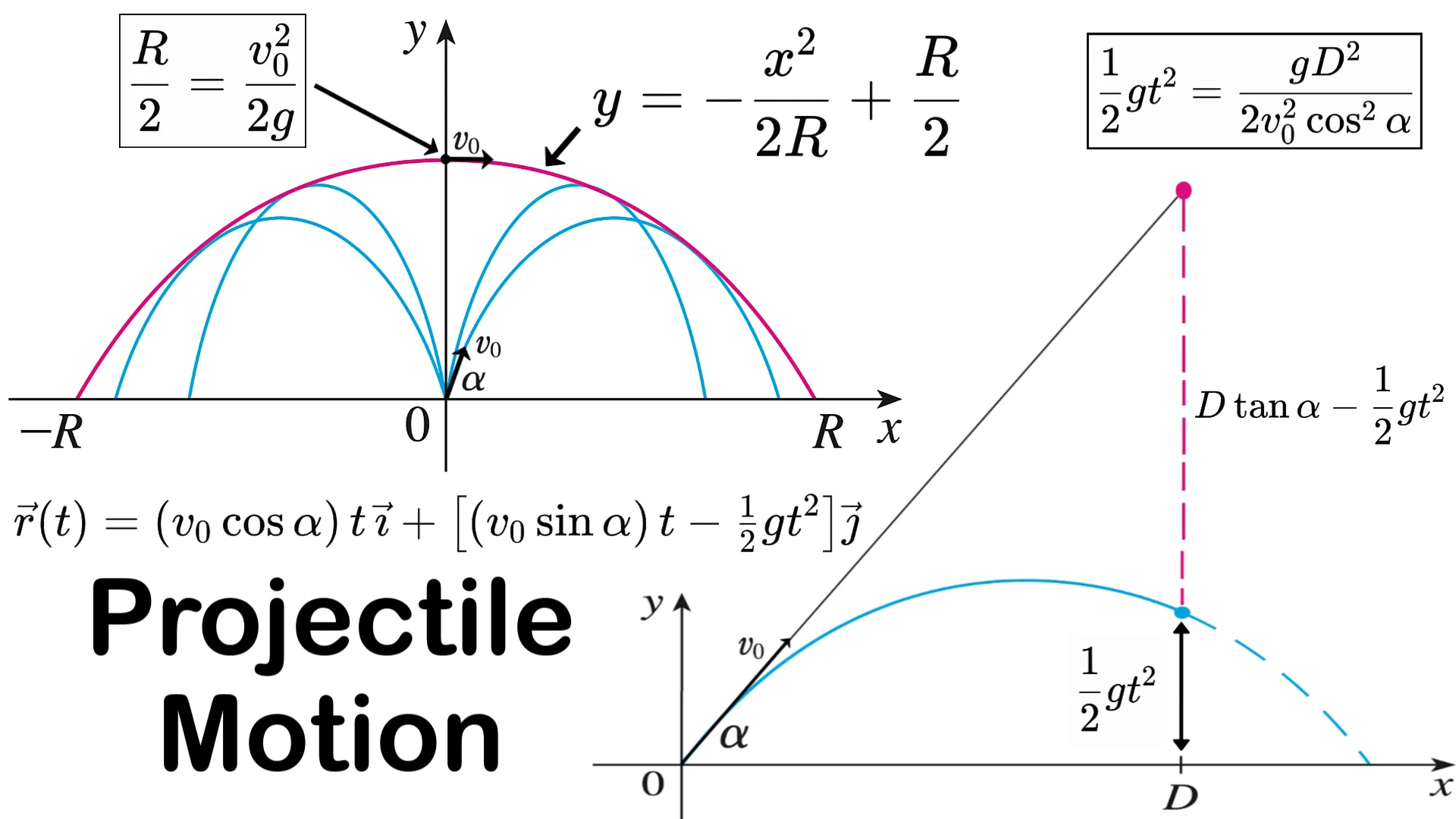
(b) Fix the initial speed v0 and consider the parabola x2 + 2Ry - R2 = 0, whose graph is shown in the figure below.

Show that the projectile can hit any target inside or on the boundary of the region bounded by the parabola and the x-axis, and that it can't hit any target outside this region.
(c) Suppose that the gun is elevated at an angle of inclination α in order to aim at a target that is suspended at a height h directly over a point D units downrange.
The target is released at the instant the gun is fired.
Show that the projectile always hits the target, regardless of the value v0, provided the projectile does not hit the ground "before" D.

Problem 2: Projectile fired down inclined plane
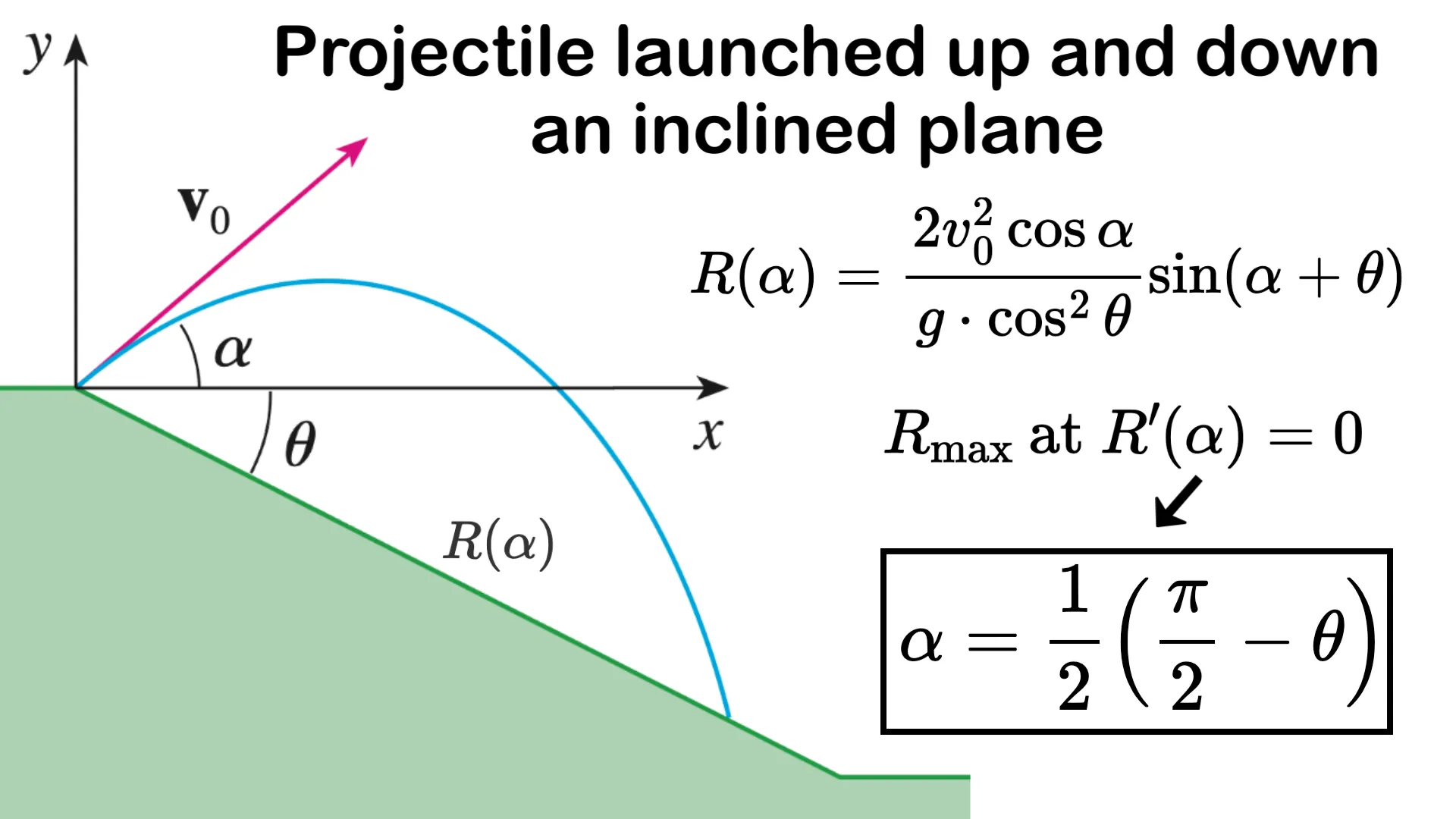
(a) A projectile is fired from the origin down an inclined plane that makes an angle θ with the horizontal.
The angle of elevation of the gun and initial speed of the projectile are α and v0, respectively.
Find the position vector of the projectile and the parametric equations of the path of the projectile as functions of time t.
Ignore air resistance.
(b) Show that the angle of elevation α that will maximize the downhill range is the angle halfway between the plane and the vertical.
(c) Suppose the projectile is fired up an inclined plane whose angle of inclination is θ.
Show that, in order to maximize the (uphill) range, the projectile should be fired in the direction halfway between the plane and the vertical.
(d) In a paper presented in 1686, Edmond Halley summarized the laws of gravity and projectile motion and applied them to gunnery.
One problem he posed involved firing a projectile to hit a target a distance R up an inclined plane.
Show that the angle at which the projectile should be fired to hit the target but use the least amount of energy is the same as the angel in part (c).
Use the fact that the energy needed to fire the projectile is proportional to the square of the initial speed, so minimizing the energy is equivalent to minimizing the initial speed.

Problem 3: Ball rolls off table
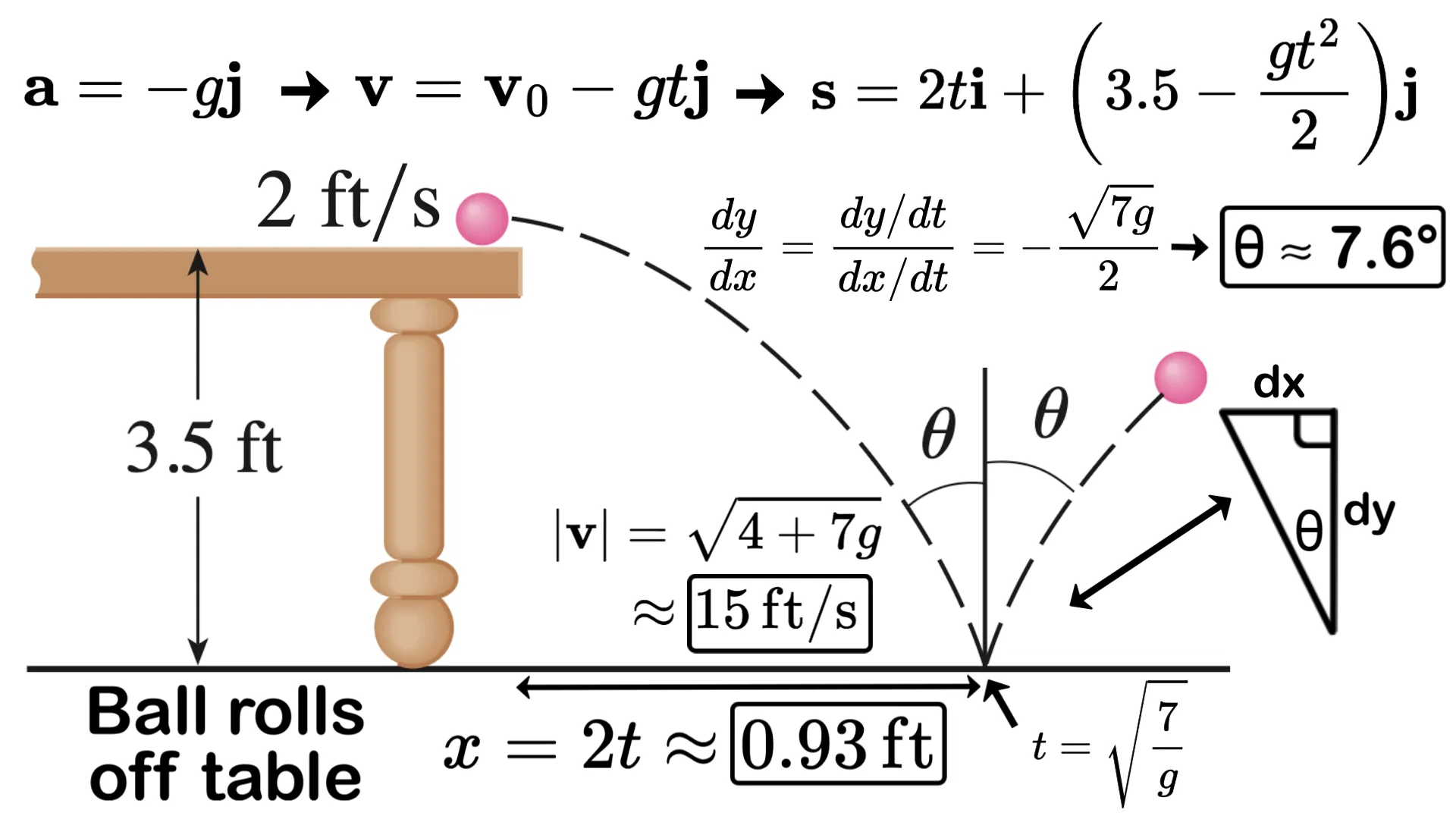
A ball rolls off a table with a speed of 2 ft/s.
The table is 3.5 ft high.
(a) Determine the point at which the ball hits the floor and find its speed at the instant of impact.
(b) Find the angle θ between the path of the ball and the vertical line drawn through the point of impact, (see the figure below).

(c) Suppose the ball rebounds from the floor at the same angle with which it hits the floor, but loses 20% of its speed due to energy absorbed by the ball on impact.
Where does the ball strike the floor on the second bound?
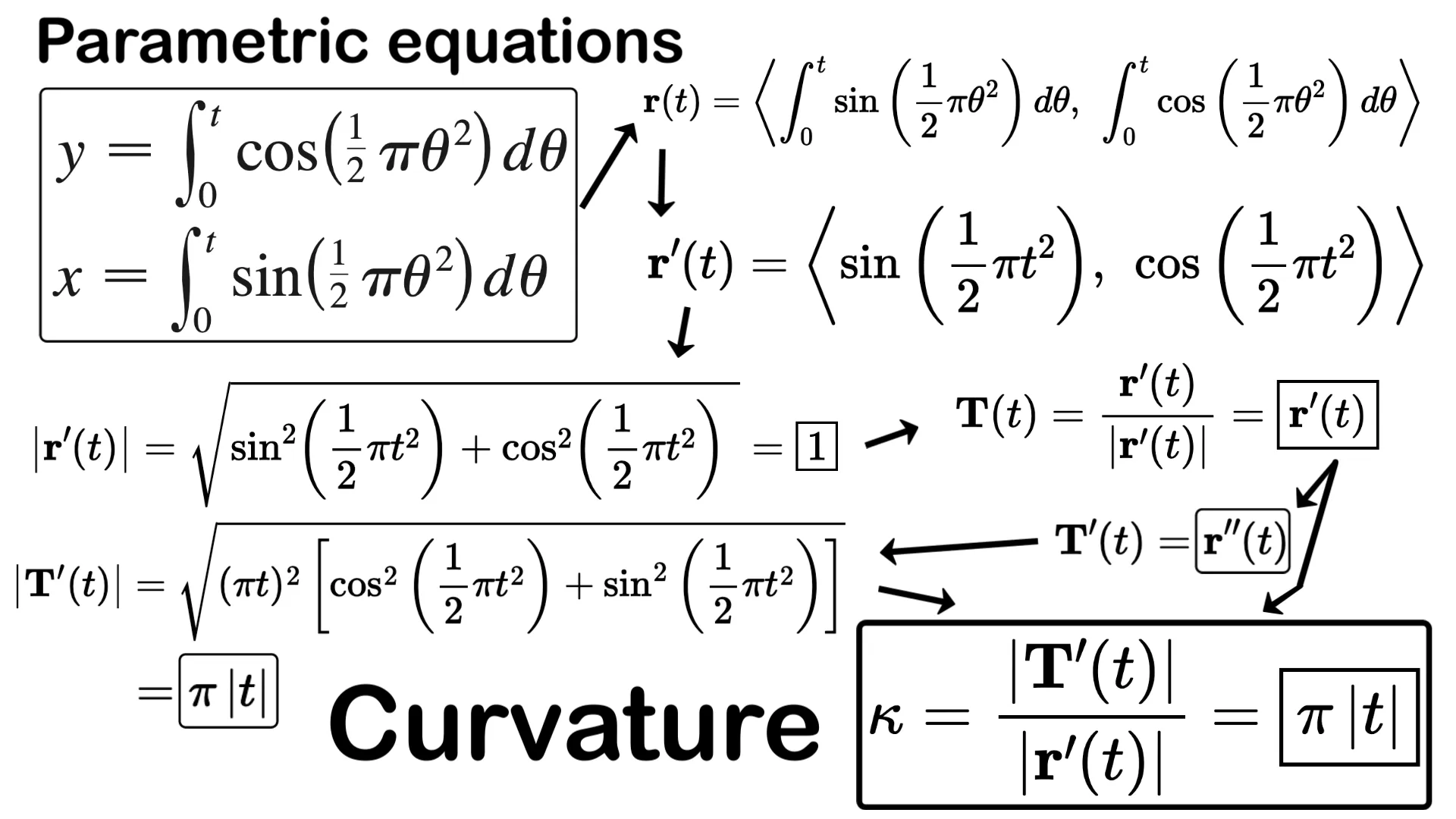
Problem 4: Curvature from Parametric Equations
Find the curvature of the curve with parametric equations:

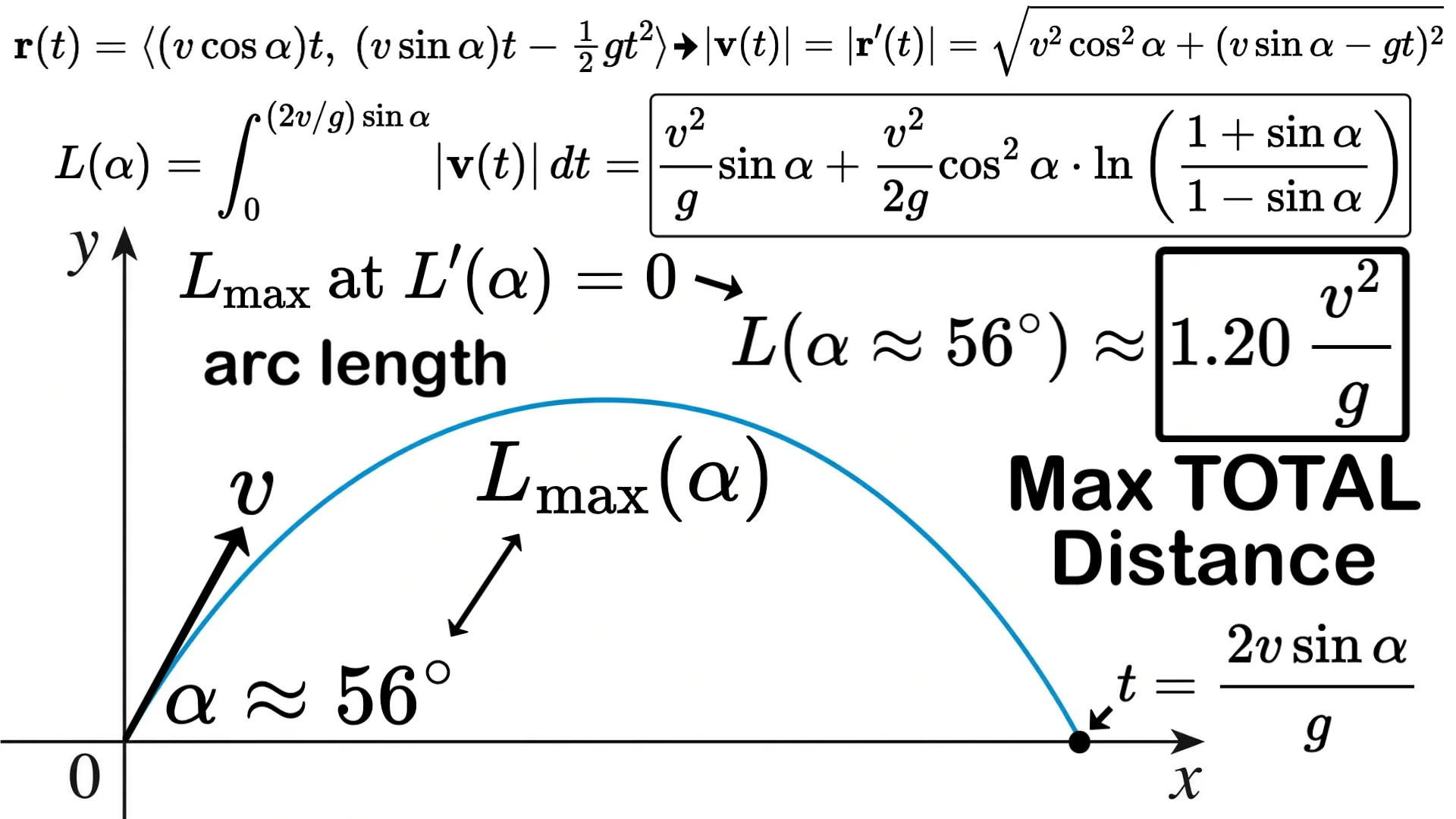
Problem 5: Total distance traveled by projectile
If a projectile is fired with angle of elevation α and initial speed v, then parametric equations for its trajectory are, as per my earlier video:

We know that the range (horizontal distance traveled) is maximized when α = 45°.
What value of α maximizes the total distance traveled by the projectile?
State your answer correct to the nearest degree.
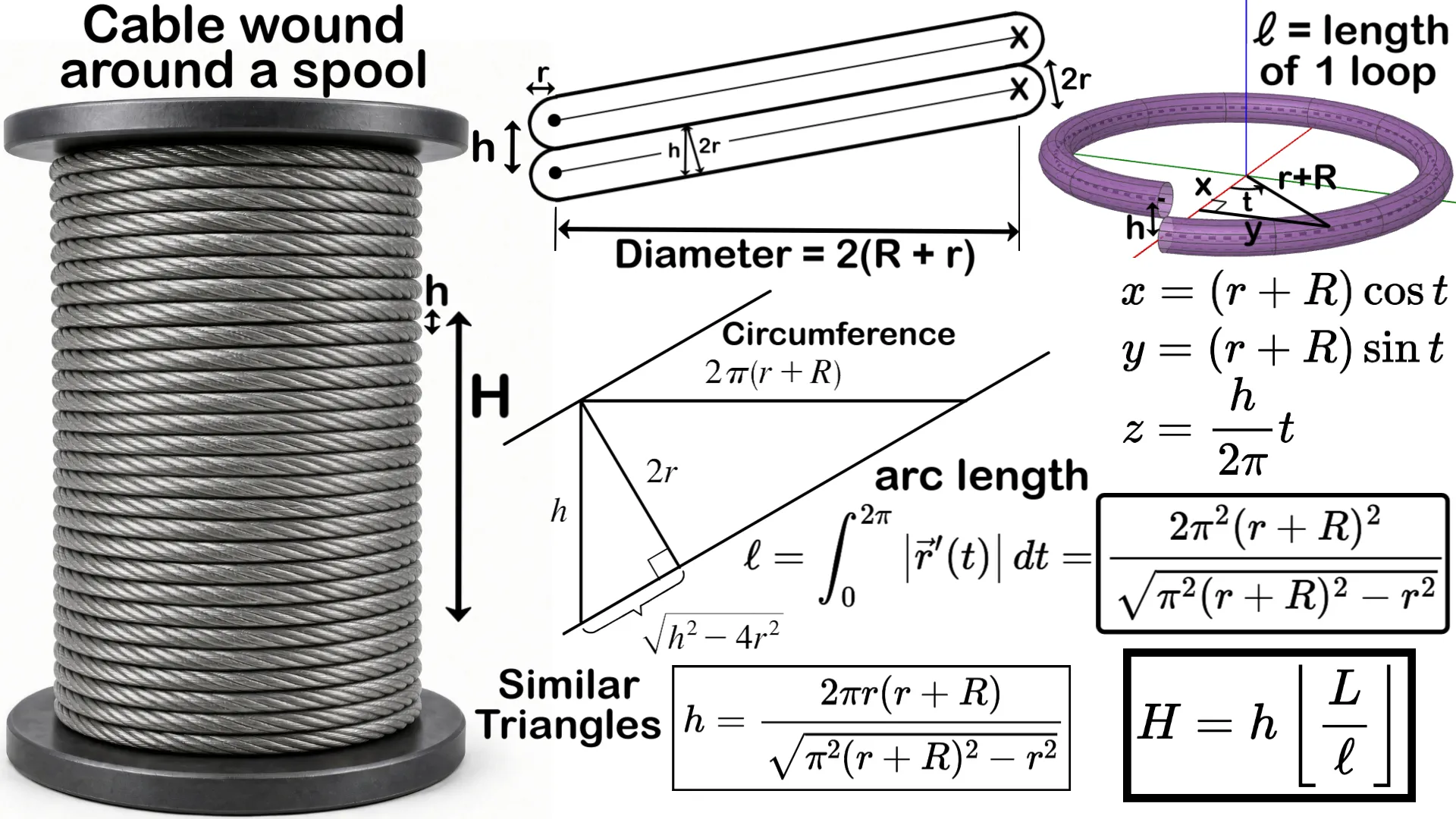
Problem 6: Cable wound around a spool
A cable has radius r and length L and is wound around a spool with radius R without overlapping.
What is the shortest length along the spool that is covered by the cable?
Problem 7: Vector equation on a plane
Show that the vector equation below lies in a plane and find the equation of the plane:

Problems Plus - Solutions
Problem 1: Projectile fired from origin
A projectile is fired from the origin with angle of elevation α and initial speed v0.
Assuming that air resistance is negligible and that the only force acting on the projectile is gravity, g, we showed in my earlier video that the position vector of the projectile is:
We also showed that the maximum horizontal distance (or range) of the projectile is achieved when α = 45° and in this case the range is R = (v0)2/ g.
(a) At what angle should the projectile be fired to achieve maximum height and what is the maximum height?
(b) Fix the initial speed v0 and consider the parabola x2 + 2Ry - R2 = 0, whose graph is shown in the figure below.
Show that the projectile can hit any target inside or on the boundary of the region bounded by the parabola and the x-axis, and that it can't hit any target outside this region.
(c) Suppose that the gun is elevated at an angle of inclination α in order to aim at a target that is suspended at a height h directly over a point D units downrange.
The target is released at the instant the gun is fired.
Show that the projectile always hits the target, regardless of the value v0, provided the projectile does not hit the ground "before" D.
Solution to (a)
The projectile reaches maximum height when:


This is the maximum height attained when the projectile is fired with an angle of elevation α.
This maximum height is largest when α = 90°, which makes sense as it means the launch angle is straight up vertically!

In that case, sin α = 1 and the maximum height is (v0)2/(2g).

Solution to (b)
We are asked to consider the parabola:

We can rearrange the parabola as an equation for y.

The points on or inside this parabola are those for which:

Recall my earlier videos on the formula for the position of a projectile:


When the projectile is fired at an angle of elevation α, the points (x, y) along its path satisfy the relations:

Recall the sine double angle identity from my earlier video.

For t in the specified range, we also have:


Now if we subtract this formula for the projectile trajectory by the formula for the parabola, we get:

Thus we have shown that every target that can be hit by the projectile lies on or inside the parabola.

Recall the Pythagorean Identity and the corresponding tangent and secant identity from my earlier videos.


Now let (a, b) be any point on or inside the parabola:

We seek an angle α such that (a, b) lies in the path of the projectile; that is, we wish to find an angle α such that:

Rearranging this equation we get:

This quadratic equation for tan α has real solutions exactly when the discriminant is nonnegative.
Recall my earlier video on the Quadratic Formula.


This condition is satisfied since (a, b) is on or inside the parabola:

It follows that (a, b) lies in the path of the projectile when tan α satisfies (*), that is, when:

Solution to (c)
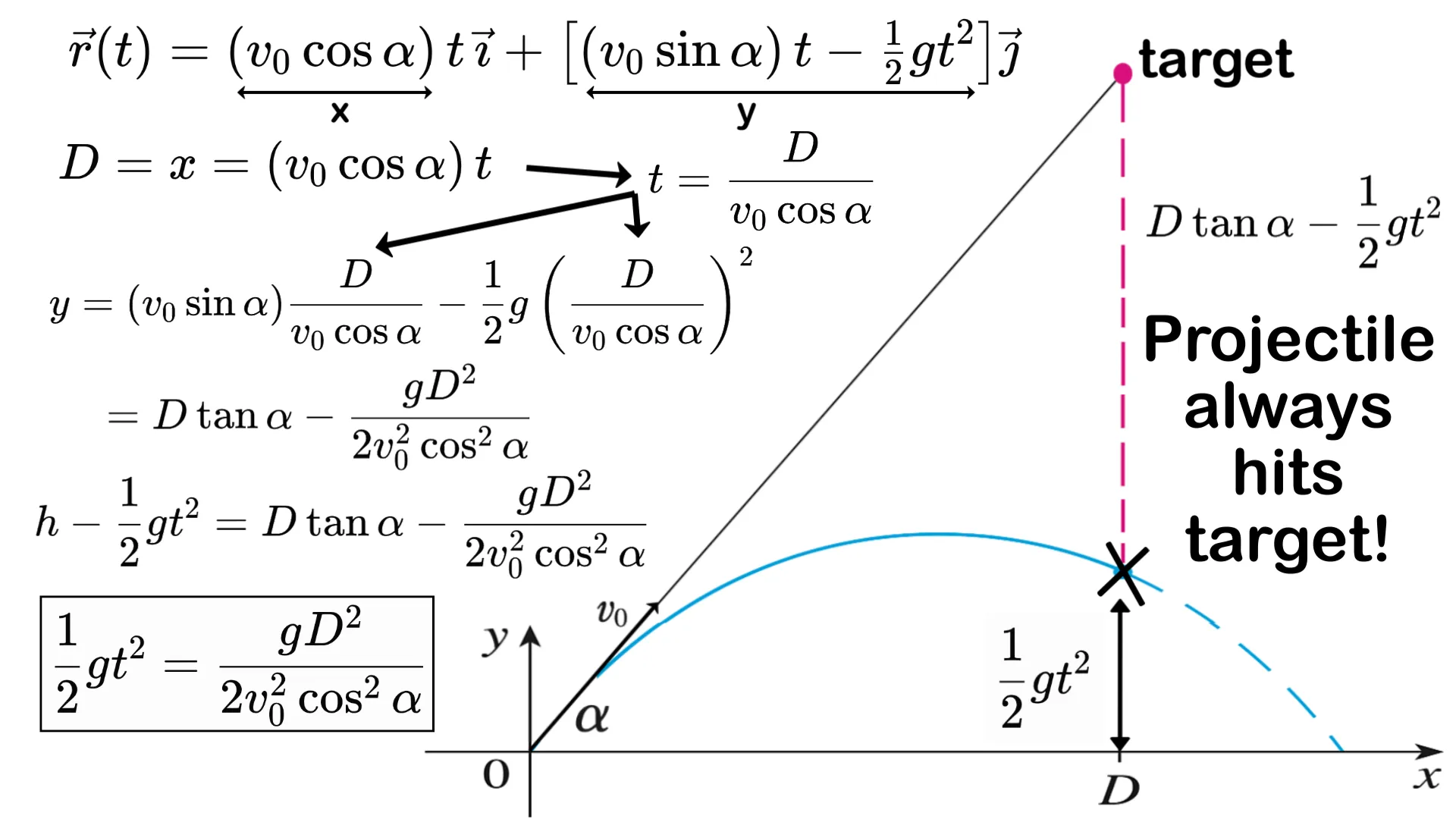
If the gun is pointed at a target with height h at a distance D downrange, then:

When the projectile reaches a distance D downrange (remember we are assuming that it doesn't hit the ground first), we have:

Meanwhile, the target, whose x-coordinate is also D, has fallen from height h to height:

Thus the projectile hits the target!

Problem 2: Projectile fired down inclined plane
(a) A projectile is fired from the origin down an inclined plane that makes an angle θ with the horizontal.
The angle of elevation of the gun and initial speed of the projectile are α and v0, respectively.
Find the position vector of the projectile and the parametric equations of the path of the projectile as functions of time t.
Ignore air resistance.
(b) Show that the angle of elevation α that will maximize the downhill range is the angle halfway between the plane and the vertical.
(c) Suppose the projectile is fired up an inclined plane whose angle of inclination is θ.
Show that, in order to maximize the (uphill) range, the projectile should be fired in the direction halfway between the plane and the vertical.
(d) In a paper presented in 1686, Edmond Halley summarized the laws of gravity and projectile motion and applied them to gunnery.
One problem he posed involved firing a projectile to hit a target a distance R up an inclined plane.
Show that the angle at which the projectile should be fired to hit the target but use the least amount of energy is the same as the angel in part (c).
Use the fact that the energy needed to fire the projectile is proportional to the square of the initial speed, so minimizing the energy is equivalent to minimizing the initial speed.
Solution to (a)
As in Problem 1:

The difference here is that the projectile travels until it reaches a point where:

From the parametric equations, we obtain:

Thus the projectile hits the inclined plane at the point where:

This means that the parametric equations are defined for t in the interval:

Solution to (b)
The downhill range (that is, the distance to the projectile's landing point as measured along the inclined plane) is:

Where x is the coordinate of the landing point calculated in part (a).

Recall the sine and cosine adding angles trigonometric identities from my earlier video.

R(α) is maximized when:


Solution to (c)
The solution is similar to the solutions to parts (a) and (b).
This time the projectile travels until it reaches a point where:

Thus we can just replace θ with -θ in Parts (a) and (b) to obtain the angle:

Solution to (d)
As observed in part (c), firing the projectile up an inclined plane with angle of inclination θ involves the same equations in part (a) and (b) but with θ replaced with -θ.
So if R is the distance up an inclined plane, we know from part (b) that:

(v0)2 is minimized (and hence v0 is minimized) with respect to α when:


Thus the initial speed, and hence the energy required, is the same angle as in part (c), and which is half the angle between the vertical and the plane.
Recall the quotient rule for derivatives from my earlier video.

Problem 3: Ball rolls off table
A ball rolls off a table with a speed of 2 ft/s.
The table is 3.5 ft high.
(a) Determine the point at which the ball hits the floor and find its speed at the instant of impact.
(b) Find the angle θ between the path of the ball and the vertical line drawn through the point of impact, (see the figure below).
(c) Suppose the ball rebounds from the floor at the same angle with which it hits the floor, but loses 20% of its speed due to energy absorbed by the ball on impact.
Where does the ball strike the floor on the second bound?
Solution to (a)
Since gravity is the only force acting on the ball when it is falling, we can derive the acceleration, velocity, and position of the ball:


Calculation check:
2*sqrt(7/32.2) = 0.932504808240314
At that instant, the ball is approximately 0.93 ft to the right of the table top.
Its coordinates (relative to an origin on the floor directly under the table's edge) are (0.93, 0).
At impact, the velocity is:

Calculation check:
Sqrt(4+7*32.2) = 15.14595655612415
Recall the distance formula in 3D (and 2D):

Solution to (b)
The slope of the curve when:

Calculation check:
atan(2/sqrt(7*32.2)) = 7.587980150526842
OneNote doesn't have inverse cotangent calculator built-in, so used WolframAlpha.
Solution to (c)
The ball rebounds with 80% of the speed of impact obtain in Part (a):

Calculation check:
0.8 * sqrt(4+7 * 32.2) = 12.11676524489932
0.8 * sqrt(4+7 * 32.174) = 12.11195772779942
Note the angle of inclination of the bounce is:

Calculation check:
90 - atan(2/sqrt(7*32.2)) = 82.41201984947315
90 - atan(2/sqrt(7*32.174)) = 82.40899026062679
Recall again my earlier video on the formula for horizontal distance d traveled by a projectile:
Thus the horizontal distance traveled between bounces is:

Calculation check:
12.11^2 * sin(2 * 82.4090)/32.174 = 1.193700857722197
2 * sqrt(7/32.174) + 1.193700857722197 = 2.126582371203312
So the ball strikes the floor at about 2.13 ft to the right of the table's edge.
Problem 4: Curvature from Parametric Equations
Find the curvature of the curve with parametric equations:

Solution:
Recall the equation of curvature and the unit tangent vector from my earlier video.

By the Fundamental Theorem of Calculus:


Recall my earlier videos on Part 1 and Part 2 of the Fundamental Theorem of Calculus.


Problem 5: Total distance traveled by projectile
If a projectile is fired with angle of elevation α and initial speed v, then parametric equations for its trajectory are, as per my earlier video:

We know that the range (horizontal distance traveled) is maximized when α = 45°.
What value of α maximizes the total distance traveled by the projectile?
State your answer correct to the nearest degree.
Solution:
The trajectory of the projectile is given by:

The distance that the projectile travels is equal to its arc length which is equal to the integral of the speed of the particle in time.


The projectile hits the ground when:

So, the distance traveled by the projectile is:

This integral is of the form in Formula 21 in the Table of Integrals at the end of my calculus book, which I also did an example on using it in my earlier video.


We want to maximize L(α) for 0 < α < π/2.


Solving by graphing (or using a Computer Algebra System (CAS)) gives α ≈ 0.9855 rad.
Calculation check:
Grok AI: α = 0.9855147378623156
Compare values at the critical point and the endpoints:

Thus the distance traveled by the projectile is maximized for α ≈ 0.9855 radians or ≈ 56°.
Calculation check:
sin(56) + 1/2 * cos(56)^2 * ln((1+sin(56))/(1-sin(56))) = 1.199599016714636
0.9855*180/pi = 56.46499071014262
Problem 6: Cable wound around a spool
A cable has radius r and length L and is wound around a spool with radius R without overlapping.
What is the shortest length along the spool that is covered by the cable?
Solution:
As the cable is wrapped around the spool, think of the top or bottom of the cable forming a helix of radius R + r, measured from the centerline of the cable.
Let h be the vertical distance between coils (ignoring the initial non-slanted coil winding), also measured from the centerline of the cable.

Then, from similar triangles:


If we parametrize the helix by:

The length of one complete cycle is the arc length:


First note that the floor function ⟦x⟧ or ⌊x⌋ represents the greatest integer less than x.

Likewise, the ceiling function ⟧x⟦ or ⌈x⌉ represents the least integer greater than x.

The number of complete cycles is ⌊L/ℓ⌋ and so the shortest length along the spool that is completely covered by the cable is:

Problem 7: Vector equation on a plane
Show that the vector equation below lies in a plane and find the equation of the plane:

Solution:
We can write the vector equation as:

This says that each tangent vector is the sum of a scalar multiple of a and the vector b.
Thus the tangent vectors are all parallel to the plane determined by a and b so the curve must be parallel to this plane.
Here we assumed that a and b are nonparallel.
Otherwise the tangent vectors are all parallel and the curve lies along a single line.

A normal vector for the plane is:

Recall my earlier video on the equation of a plane from the normal vector:

The point (c1, c2, c3) lies on the plane (when t = 0), so an equation of the plane is:
