
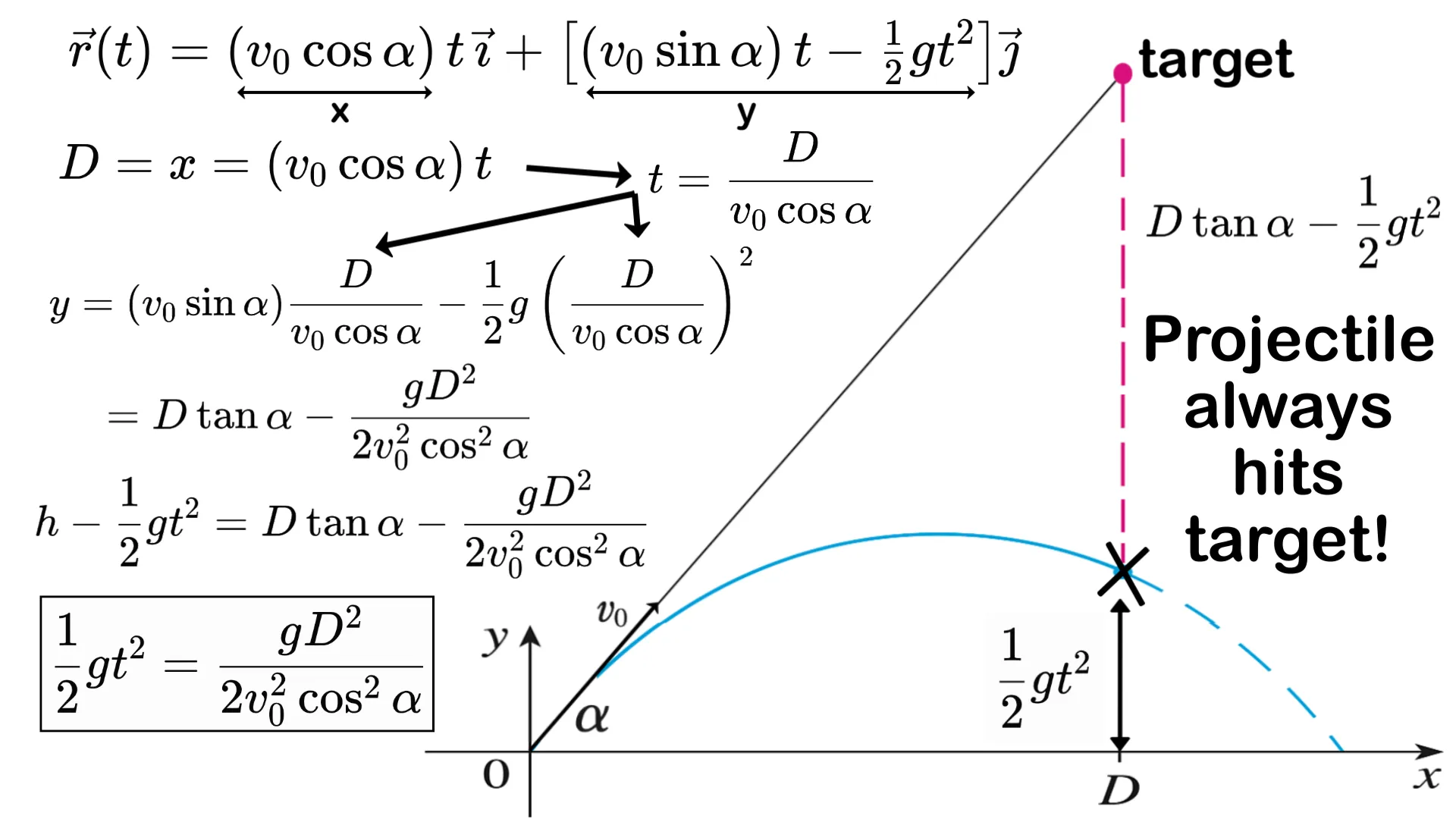
In this video, I show that firing a projectile while aiming at a distance target downrange and dropping it at the same time will always cause the projectile to hit the target, provided that the projectile doesn't hit the ground before reaching the target. This is because both the projectile and object accelerate downwards at the same rate due to gravity, and this is represented in the (-1/2)gt² term of the y-component in the parametric equations of projectile motion. This result is pretty amazing, and allows for some pretty cool stunts and trick shots to attempt!
Solution to Problem 1
Full written solution to part (c) only — mirrored from Vector Functions: Problems Plus, which also covers parts (a) and (b), and Problems 2–7.
A projectile is fired from the origin with angle of elevation α and initial speed v0.
Assuming that air resistance is negligible and that the only force acting on the projectile is gravity, g, we showed in my earlier video that the position vector of the projectile is:

We also showed that the maximum horizontal distance (or range) of the projectile is achieved when α = 45° and in this case the range is R = (v0)2/ g.
(a) At what angle should the projectile be fired to achieve maximum height and what is the maximum height?
(b) Fix the initial speed v0 and consider the parabola x2 + 2Ry - R2 = 0, whose graph is shown in the figure below.

Show that the projectile can hit any target inside or on the boundary of the region bounded by the parabola and the x-axis, and that it can't hit any target outside this region.
(c) Suppose that the gun is elevated at an angle of inclination α in order to aim at a target that is suspended at a height h directly over a point D units downrange.
The target is released at the instant the gun is fired.
Show that the projectile always hits the target, regardless of the value v0, provided the projectile does not hit the ground "before" D.

Solution to (c)
If the gun is pointed at a target with height h at a distance D downrange, then:

When the projectile reaches a distance D downrange (remember we are assuming that it doesn't hit the ground first), we have:

Meanwhile, the target, whose x-coordinate is also D, has fallen from height h to height:

Thus the projectile hits the target!

- Watch on: 3Speak · YouTube · Telegram
- Full written solution: Vector Functions: Problems Plus
- More math: mes.fm/math
Originally posted on the Hive blockchain →