
In this video, I go over the physics of a ball rolling off a table and determine how far it falls, the angle and speed it bounces with, and the distance it travels for a second bounce after losing 80% of its energy upon impact. I first obtain the position vector of the falling ball by taking integrals of the acceleration and velocity vectors. Then I determine the time until it reaches the ground, which allows obtaining the distance traveled. The slope of impact is just the derivative, thus we can then use trigonometry to obtain the angle it bounces with. Finally, I use the distance formula of projectile motion from my earlier video to find the distance of the second bounce, and thus the total distance the ball travels.
- Watch on: 3Speak · YouTube · Telegram
- Full written solution: Vector Functions: Problems Plus
- More math: mes.fm/math
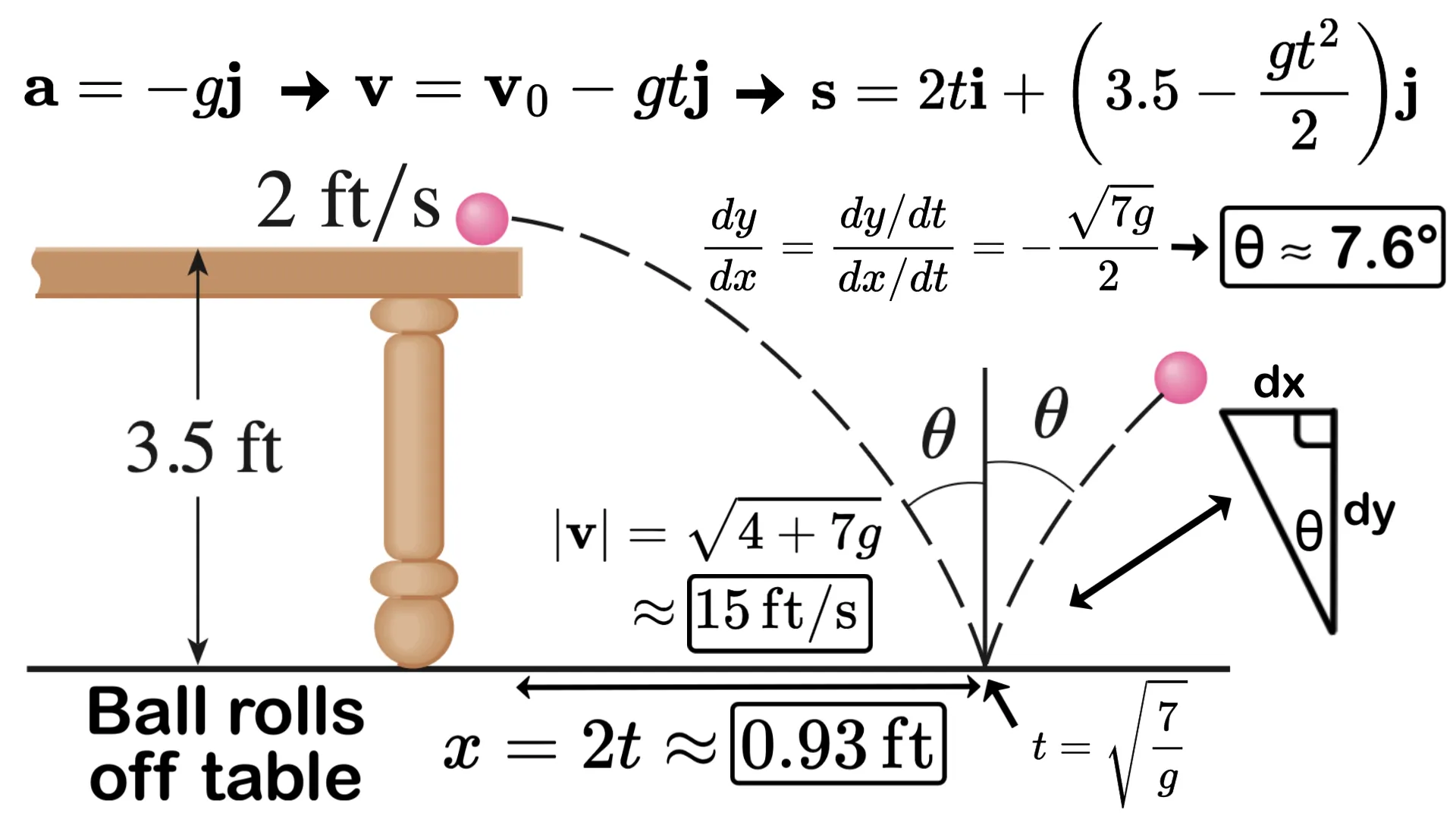
Solution to Problem 3
Full written solution to parts (a), (b) and (c) — mirrored from Vector Functions: Problems Plus, which also covers Problems 1, 2, and 4–7.
A ball rolls off a table with a speed of 2 ft/s.
The table is 3.5 ft high.
(a) Determine the point at which the ball hits the floor and find its speed at the instant of impact.
(b) Find the angle θ between the path of the ball and the vertical line drawn through the point of impact, (see the figure below).

(c) Suppose the ball rebounds from the floor at the same angle with which it hits the floor, but loses 20% of its speed due to energy absorbed by the ball on impact.
Where does the ball strike the floor on the second bound?
Solution to (a)
Since gravity is the only force acting on the ball when it is falling, we can derive the acceleration, velocity, and position of the ball:


Calculation check:
2*sqrt(7/32.2) = 0.932504808240314
At that instant, the ball is approximately 0.93 ft to the right of the table top.
Its coordinates (relative to an origin on the floor directly under the table's edge) are (0.93, 0).
At impact, the velocity is:

Calculation check:
Sqrt(4+7*32.2) = 15.14595655612415
Recall the distance formula in 3D (and 2D):

Solution to (b)
The slope of the curve when:

Calculation check:
atan(2/sqrt(7*32.2)) = 7.587980150526842
OneNote doesn't have inverse cotangent calculator built-in, so used WolframAlpha.
Solution to (c)
The ball rebounds with 80% of the speed of impact obtain in Part (a):

Calculation check:
0.8 * sqrt(4+7 * 32.2) = 12.11676524489932
0.8 * sqrt(4+7 * 32.174) = 12.11195772779942
Note the angle of inclination of the bounce is:

Calculation check:
90 - atan(2/sqrt(7*32.2)) = 82.41201984947315
90 - atan(2/sqrt(7*32.174)) = 82.40899026062679
Recall again my earlier video on the formula for horizontal distance d traveled by a projectile:

Thus the horizontal distance traveled between bounces is:

Calculation check:
12.11^2 * sin(2 * 82.4090)/32.174 = 1.193700857722197
2 * sqrt(7/32.174) + 1.193700857722197 = 2.126582371203312
So the ball strikes the floor at about 2.13 ft to the right of the table's edge.
Originally posted on the Hive blockchain →