
In this video, I calculate the height covered by a coil of cable of known length around a spool, counting only the portion of the height that includes a full loop. I first note that as a cable is wound in one direction, it forms a consistent angle as it wraps around itself. Unwinding it completely while keeping the angle forms a straight line, which we can then use similar triangles to obtain the vertical distance between two successive loops of the cable. The length of each loop can be obtained by using the arc length formula and parametric equations of the coil. Finally, the total height covered by the cable is the vertical distance between two loops multiplied by the floor function of the total cable length divided by the length of each loop. The floor function is the greatest integer less than a given number, and in our case represents the number of loops completely covered by the cable (i.e. excluding partial loops). This is a fascinating look at the complex physics of winding a simple cable around a spool!
- Watch on: 3Speak · YouTube · Telegram · Rumble · BitChute · Odysee
- Full written solution: Vector Functions: Problems Plus
- More math: mes.fm/math
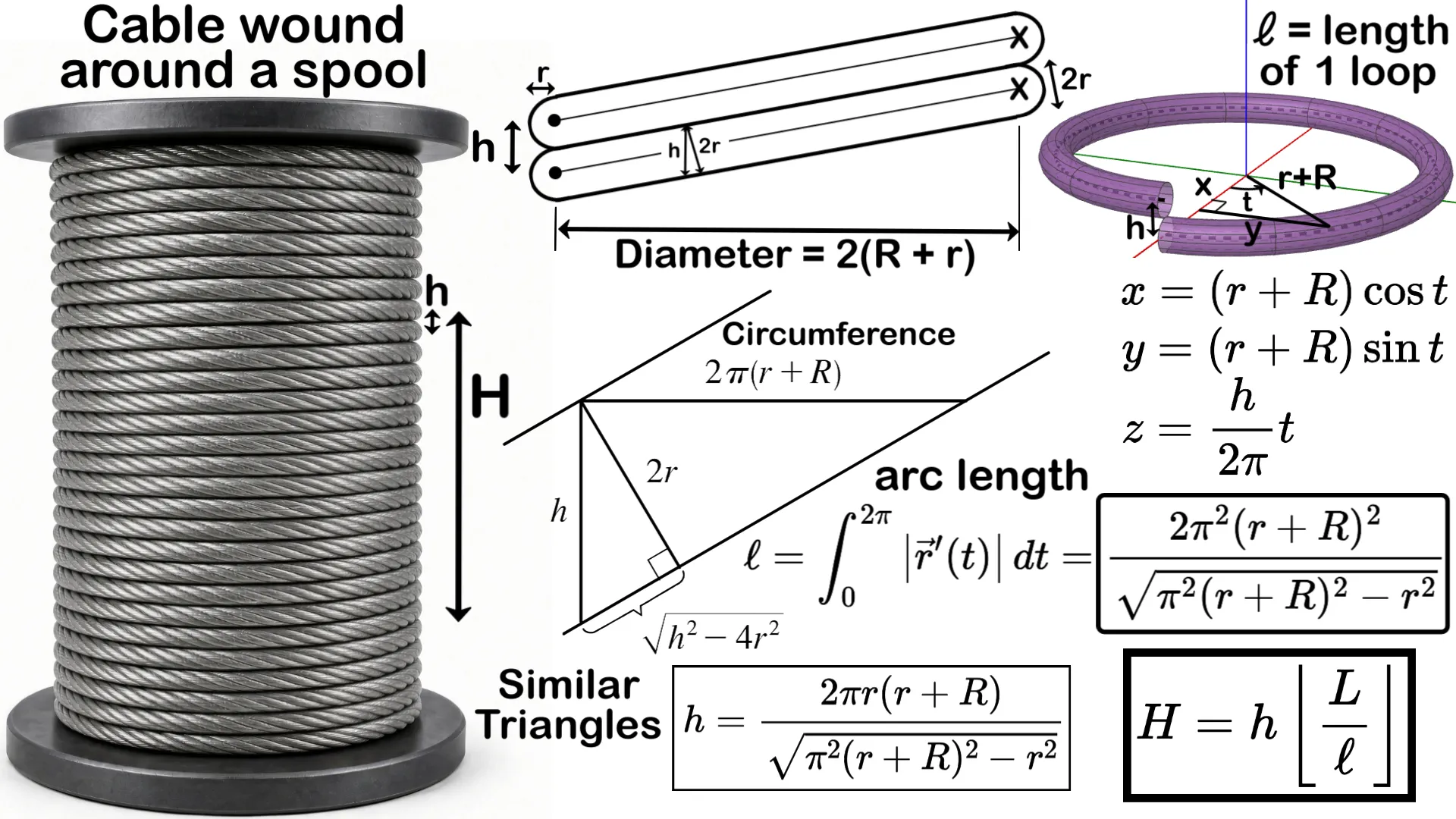
Solution to Problem 6
Full written solution — mirrored from Vector Functions: Problems Plus, which also covers Problems 1–5 and 7.
A cable has radius r and length L and is wound around a spool with radius R without overlapping.
What is the shortest length along the spool that is covered by the cable?
Solution:
As the cable is wrapped around the spool, think of the top or bottom of the cable forming a helix of radius R + r, measured from the centerline of the cable.
Let h be the vertical distance between coils (ignoring the initial non-slanted coil winding), also measured from the centerline of the cable.

Then, from similar triangles:


If we parametrize the helix by:

The length of one complete cycle is the arc length:


First note that the floor function ⟦x⟧ or ⌊x⌋ represents the greatest integer less than x.

Likewise, the ceiling function ⟧x⟦ or ⌈x⌉ represents the least integer greater than x.

The number of complete cycles is ⌊L/ℓ⌋ and so the shortest length along the spool that is completely covered by the cable is:

Originally posted on the Hive blockchain →